Nature
 PUBLISHED
 2
2




Gold has captivated humans for millennia, but it comes in many different forms out in the wild. Among the rarest and most peculiar is crystalline gold, which forms deep underground and maintains its original shape – crafted by the formation of cracks in Earth’s crust.
It requires the right combination of temperature, pressure, and chemistry for gold to form in a repeating pattern that builds up into crystals. The resulting shapes can be cubes, octahedra, or branching “dendritic” (tree-like) structures, but it’s rare for that shape to be maintained.
Gold has often travelled a long way before we find it, by which time it has been smoothed out and eroded into more typical nugget-like shapes. This is what makes crystalline gold nuggets so rare and intriguing, as they’ve escaped that wear and tear to maintain their original shape.
The crystalline gold forms deep underground in cracks between rock, and then gets brought to the surface as the rock itself moves (never a bad time to remember the Earth is basically a big magma puzzle). The steps required for crystalline gold to be preserved are so precise that it’s thought to account for just 1 percent of the world's gold.
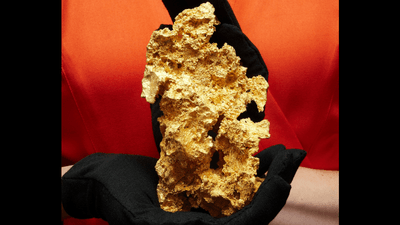
That rarity means crystalline gold nuggets are often sold for far more than their weight in gold, because they’re like their own kind of art. Such a nugget was recently added to Heritage’s Nature & Science Signature Auction, and it’s a whopper.
“The most obvious attribute of this exemplary Crystalline Gold Nugget is its size – the total weight of the massive specimen is 53.67 troy ounces [1.7 kilograms],” reads Heritage's listing for the gold. “From Western Australia, the enormous stunner has an artistic natural shape with incredible dimensionality. Folds of the leafy and foil-like precious metal have grown in such a way as to result in a work of art piece measuring over 5.5 inches [14 centimeters] long.”
The Ironstone’s Crown Jewel is thought to be the world’s largest crystalline gold nugget. Weighing 44 troy pounds (16.4 kilograms), it was found in 1992 by the Sonora Mining Company. It was embedded in quartz, but extracted using acid, revealing an enormous single mass of crystalline gold.
Natural crystalline gold is remarkable to behold, but did you know we can also make synthetic gold crystals in the lab? All you need is a nuclear reaction, a particle accelerator, or the blast of a supernova.