Nature
 PUBLISHED
 1
1


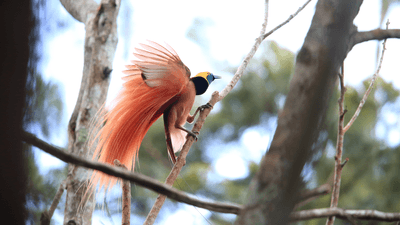


One of the world’s greatest examples of sexual selection is the elaborate performances put on by birds-of-paradise, and it’s possible the female’s choosiness may be a way of avoiding mating with males of the wrong species. However, new research has revealed that this isn’t always enough to prevent mating between species, as it has identified some rare birds-of-paradise hybrids.
A hybrid is the offspring of two plants or animals that are different species, and we’ve seen remarkable examples in nature in the form of grolar bears, coywolves, and sturddlefish. The resulting animal borrows phenotypic traits from both species, which was the first clue for scientists in establishing if such hybrids existed among birds-of-paradise.
There had been reports of “odd-looking males” entering museum collections that were notable for having the breast feathers of one species, while also having the tail feathers of another. To look into the evolutionary consequences of such hybridization events between these animals, researchers led by Dr. Mozes Blom from Museum für Naturkunde, Berlin, and Dr Martin Irestedt from the Swedish Museum of Natural History decided to compare the genomes of different specimens.
Their focus was the birds-of-paradise family Paradiseaidae, found in Australasia. The ornately plumaged males in this group put on the performance of a lifetime to win favor with picky females, which got the team wondering: what happens when a male of the wrong species slips past her quality assurance checks?
The results of their investigations have been published in two papers, revealing that rare hybrids do exist among birds-of-paradise with wildly different parents. In fact, not only are there hybrids, but some of them are the result of multiple rounds of hybridization, which is significant because it indicates that the hybrid offspring aren’t necessarily infertile – something that’s not uncommon among hybrids. The recurring process means that the genetic material of one species is repeatedly found in the genome of the other, suggesting the hybrids have been reproducing and exchanging their DNA.

"Our two studies shed new light on the evolutionary consequences of hybridization in organismal groups with strong forms of sexual selection," said Blom in a statement sent to IFLScience. "Our findings not only confirm that it is indeed still possible to produce fertile offspring between species, where the males differ so radically in traits that are a key indicator for female preference, it has actually also resulted in the sharing of genes between species.”
“There is a growing body of work which indicates that hybridization may lead to phenotypic diversification and our findings surprisingly suggest that this may still hold true for species with extreme forms of sexual selection. However, many questions remain, in particular regarding the functional significance of genes that have been shared between species and why females occasionally make 'mistakes' in the first place and mate with a male that is very obviously not of her own species".
The studies are published in Evolution Letters and iScience.