Nature
 PUBLISHED


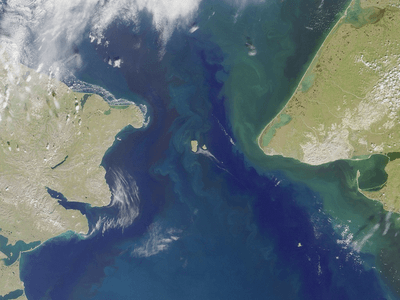


In a desperate effort to save an ocean current essential for hundreds of millions of people’s quality of life, a radical proposal to dam the Bering Strait has been floated. Before considering the practicality and ethics of such a task, scientists decided to ask whether it would even work as intended. Their answer is: maybe, but only if the timing is right.
The Atlantic Meridional Overturning Circulation (AMOC) is vital for many aspects of the modern world. It’s the reason Northern Europe can support a substantial population in reasonable comfort, and even feed most of them without imports. It also helps prevent sea level rise from accelerating drastically along parts of North America’s Atlantic coastline, and causes the oceans to draw enough carbon dioxide out of the atmosphere to cool the world by 0.2 degrees. So it’s terrifying that much, although not all, evidence suggests it is weakening and could collapse this century.
The idea that doing something where the Pacific Ocean meets the Arctic would affect a current in another ocean seems absurd. However, the idea does not come from nowhere. The Bering Strait has been blocked in the past, and not only during ice ages, explaining why Asia and North America’s animals have so much in common. Palaeoclimatological evidence indicates that during periods when the Bering Strait was blocked, the AMOC was more stable than when water flowed through the Strait.
Utrecht University PhD student Jelle Soons and supervisor Professor Henk Dijkstra set out to explore whether artificial blocking could save the AMOC.
The reason the Bering Strait’s existence can pose a threat to the AMOC is that most of the time, water flows through it from the Pacific to the Arctic, and this water is exceptionally fresh. The arrival of that water makes the Arctic fresher than it would be otherwise, and some of that relatively fresh water makes its way around Greenland into the North Atlantic. Since the primary threat to the AMOC is extra fresh water produced by accelerated melting of Greenland’s ice, making the Arctic flow saltier has its appeal.
Nevertheless, the climate is such a complex system that Soons and Dijkstra wanted to know if this is really how things would pan out. Their models of existing currents, and the response to a blockage, indicate that yes, damming the Bering Strait could work, but only if you did it while the AMOC is still at historically normal levels.
In that scenario, the flow around Greenland becomes saltier, leaving room for Greenland’s ice to melt faster without causing the AMOC to collapse.
There are, however, several very important caveats to this. The obvious one is that this is modeling we can’t exactly test, and the conclusions could be wrong. A second is that such a dam is not a get-out-of-jail-free card for the AMOC. If Greenland melts fast enough, the AMOC will collapse, dam or no dam, so reigning in Greenhouse gas emissions would still be essential – we’d just have a little more leeway.
However, the third caveat is the most surprising. Soons and Dijkstra’s modeling indicates that if the Strait was dammed when the AMOC was already substantially weakened, it would make things worse. Instead of causing saltier water to flow through the Labrador Sea, the dam’s key outcome would be to increase Arctic Ocean sea ice. Although this would have other benefits, it would reduce evaporation, making the outflow less saline and therefore AMOC poison.
The model indicates a tipping point when the AMOC falls below 16.4 million cubic meters per second, 16 percent below original levels: after that, damming the Strait would worsen the problem. It’s possible we are already there, and certainly could be by the time work finished, even if we started immediately.
Assuming the broad principles are right, when it comes to calculating the exact value of the tipping point, initial modeling like this needs to be taken with a dose of salt so large it might resalinize the North Atlantic.
Whether damming the Bering Strait would even be practical is another matter. The strait is 82 kilometers (50 miles) wide. It’s mostly about 50 meters (170 feet) deep, which is why it has blocked naturally when sea levels were lower. As an engineering scheme, a dam would require a fraction of the material in the Great Wall of China, and a bit more than twice South Korea’s Saemangeum Seawall, but this is a much less accessible location. Any dam would need to be able to resist the flow of water; that’s the reason it would be built at all.
However, the obstacles to building it would be more geopolitical than physical. Saving the AMOC would benefit the whole world, but primarily north-western Europe. Almost exactly half the dam would need to be built in Russian territory, however, giving the Russian government the power to bring Europe to its knees if it felt like destroying its half.
Such a dam would presumably also be a calamity for species that migrate through the Strait, such as Bowhead whales. More importantly, however, this work proves how delicate a mechanism the global climate can be, and how interventions could have unexpected consequences.
Maybe it would be easier to just cut back on the coal and oil after all.
The study is open access in Science Advances.