Space and Physics
 PUBLISHED
 1
1


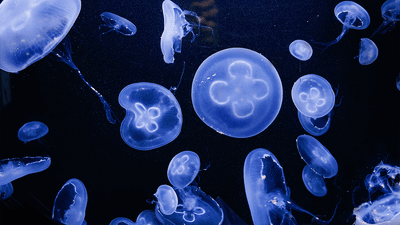


Cosmic jellyfish aside, jellyfish are not an animal that you would expect to encounter in space too much. But at one point in the 1990s, 60,000 jellyfish spent time in space aboard the European Space Agency's Spacelab, as part of a project to see how they would cope with a microgravity environment.
Generally, when animals are sent to the ISS, it is to study the effect that microgravity may have on humans. For this reason, a lot of studies have focused on mice and rats.
"Since the environment of space alters multiple, interacting biological systems – including bones, muscles, the heart, blood flow, and the immune system – sometimes it is better to study everything at once in the entire organism," NASA explains. "The rodents’ faster development and shorter life span reveal effects of microgravity on a shorter timescale, and the chance to fly dozens of small rodents on each mission yields much more data from which to draw scientific conclusions."
But other species, such as Japanese red-bellied newts, have made their way onto humanity's orbiting laboratory, sometimes for their ability to undergo physiological adaptations within a short time period, making the effects of microgravity easier to study.
"Species are often selected on the basis of their capacity to undergo some physiological adaptation process or life-cycle stage within a short period of time. For example, Japanese red-bellied newts were selected for experiments on the International Microgravity Laboratory 2 (IML-2) payload because their vestibular systems would undergo most of their development within the planned duration of the Shuttle flight," a 1995 NASA report explains.
"Other organisms are chosen because they are resilient and can be easily cared for in an automated setting where food, water, and appropriate environmental conditions can be provided but where human caretakers may not be available."
Jellyfish were partly chosen for these reasons, but there is another interesting aspect to them that earned them a ticket to low-Earth orbit on board Columbia. These animals have gravity-sensing organs known as statoliths, which have been well-studied by biologists, making them excellent candidates for learning more in general about gravity-sensing mechanisms and their development in a microgravity environment. As well as this, scientists were interested in whether the asexually reproducing polyp form of jellyfish would develop normally in microgravity in general.
The study, named somewhat simply the Jellyfish-in-Space Experiment, saw 2,478 healthy Aurelia aurita (moon jelly) polyps taken to the Kennedy Space Center, where they were divided up into groups before launch. In space, they spent their time in a temperature-controlled incubator, missing out on the views. Meanwhile, healthy controls on the ground were kept at the same temperature and conditions during the nine-day mission, other than the lack of gravity, of course.
So, how did they fare? To a certain extent, pretty well.
"Examination of living ephyrae with the light microscope and fixed ones with the Scanning and Transmission Electron Microscopes revealed that those which developed in space were morphologically very similar to those which developed on Earth," one study on the jellyfish explains, adding that there were no significant differences in the number of limbs developed by the jellyfish, compared with those that remained on Earth.
But it wasn't all good news, with many of the jellyfish that developed in space having difficulty adjusting to Earth's gravity. These are space jellies, after all.
"Pulsing abnormalities, however, were found in greater numbers (18.3%) in space-developed ephyrae than in Earth-developed controls (2.9%)," the team explained. "These abnormalities suggest abnormal development of the graviceptors, the neuromuscular system, or a defect in the integration between these systems in apparently microgravity-sensitive animals."
As well as this, male space jellies were found to live slightly less long than their earthly counterparts, and there was a decrease in the number of embryos that hatched whilst in space. Though not of immediate urgency, the research could indicate that humans could have development issues if they were conceived or gestated in a microgravity environment.
But the main takeaway from this is, there are jellyfish out there that know what it feels like to go to space, even if they have no awareness of what any of that means, or why they are swimming all funny.