Culture and Society
 PUBLISHED


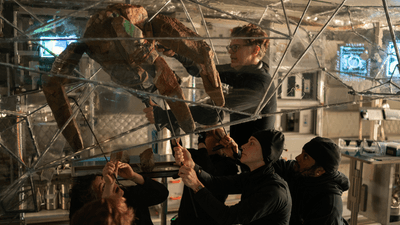


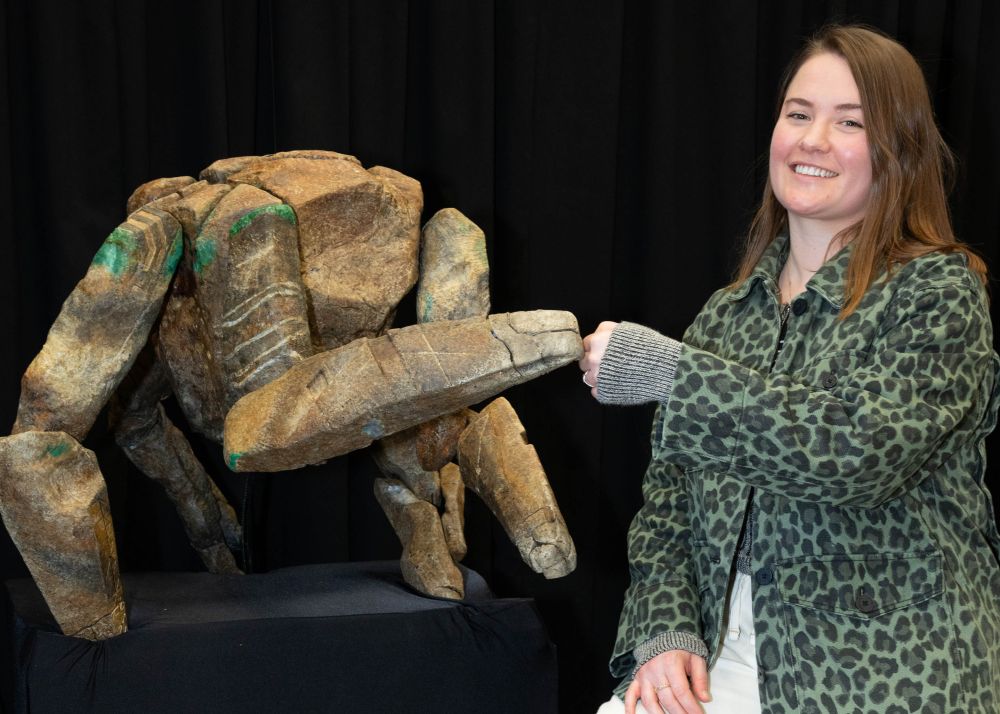
Upon meeting Rocky the Eridian, it’s hard to know where to look. There’s the distracting nature of his five limbs, and that you can’t quite figure out which of those limbs is an arm or a leg or both. Then, there’s the fact that Rocky doesn’t have a face. Or at least, that’s what I thought.
According to the Creature Shop artists who helped bring this Project Hail Mary character to life, Rocky actually has a few. Each is masterfully crafted so that they give his character a focus center without ever having facial features.
I can see what they mean as I stand in a warehouse in London that’s filled to the rafters with fantastical creatures from blockbuster movies. It’s the workplace of special effects artist Neal Scanlan, known for his creature creations in Star Wars and Jurassic World.
Rocky’s boulder-like body comes complete with smooth surfaces that my anthropomorphizing brain just can’t help but interpret as faces. Still, I think, it’s not much for co-star Ryan Gosling to bounce off on set, but as I was about to learn, he was far from alone.
In an era where visual FX have created entire worlds for our eyes to get lost in, there’s a certain kind of magic to discovering a new movie doing things the “old fashioned” way. Despite its futuristic setting, the directors of Project Hail Mary wanted to use as little special effects as possible. Instead, they opted for a physical puppet.
Two, in fact. One was captained by actor and puppet designer James Ortiz who became the voice of Rocky. He was assisted by “The Rocketeers” – an all-female team that learned how to move as one while navigating Rocky’s five limbs through a movie set that was far more crowded than the final cut suggests (sidenote: it’s not easy post-editing out faces when you’re surrounded by highly-reflective “xenonite”, the fictional, incredibly strong material developed by the Eridians in the film).
There was another Rocky, however. One that builds on the “Waldo” digital puppetry system that was first developed in the 1980s at the Jim Henson Creature Shop, where Scanlan used to work.
In scenes where there wasn’t room for The Rocketeers, a remote model of Rocky was physically manipulated off-camera to influence the movements of an on-camera animatronic duplicate. More to do with complex wiring than magic, but it was pretty spectacular to witness an Eridian moving seemingly of its own free will.
Scanlan and Ortiz lead the tour of the Creature Shop, but in truth it took the collaboration of teams of people to take author Andy Weir’s vision of Eridian biology and build it into being. Everything from the way an Eridian moves to how it takes on injuries had to be taken into account for the final design – the latter of which required adding significant volumes of makeup to the puppet. They really are just like movie stars.
A complex task, perhaps unsurprisingly given the degree of research Weir put into creating Erid and its inhabitants.

“I started off with a real exoplanet that I chose, which has since been proven to not exist, but let's get past that,” Weir told IFLScience. “At the time I wrote it, it was believed that it existed and it was a planet very close to the star 40 Eridani – so close that it orbits once every 46 days. So, it's considerably closer to its star than Mercury is to ours.”
“So, I was like, well, that's where I want a whole active biosphere to exist. It needs liquid water, but how can something be that close to a star and have liquid water? My answer was: it'll be really hot, but it'll also have a tremendous air pressure because if you increase the air pressure, you increase the boiling point of water.”
"That's why when you get all the way down to the surface, you've got the Erdians, which is like the apex predator of their planet, just like we're the apex predators of our planet, so I had to design their morphology and biology around those constraints."
“I went way down all kinds of rabbit holes to design Eridian biology. Their body is basically a sealed ecosphere internally, and they only open anything – they only interact with the outside world – to excrete and eat. That's it. They don't breathe. They internally deal with gas exchange.”
“With that in mind, I'm like, ‘They can't just take in air and then spit it out to make sounds like we do’. So, they have to have internal sound bladders or something like that. Basically pushing air back and forth across something like vocal cords.”
Check out our full interview with Andy Weir to find out what he thought that should sound like (featuring an excellent impression of a whale).