Space and Physics
 PUBLISHED
 1
1


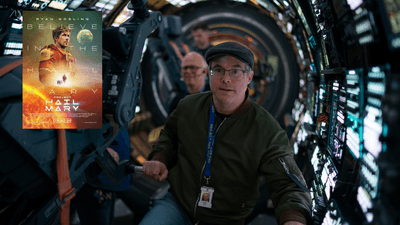


What would it be like to wake up alone in space? If you asked Project Hail Mary’s Ryland Grace (played by Ryan Gosling in the new movie adaptation), I suspect he’d say two things: tubes. Lots of tubes.
The opening to this intergalactic adventure sees our unlikely hero grapple with a new and frightening reality as it’s revealed he’s trapped on a spaceship with no idea where he is or why he’s there. The story returns to him in dribs and drabs until he makes the grim realization that the fate of Earth rests on his shoulders.
Turns out, ours isn’t the only planet facing annihilation. Joined by Rocky the Eridian – an alien species it feels reductive to describe as spider-like despite all the “legs” – Grace gets to work trying to figure out how to topple a miniature but deadly enemy: astrophage.
What follows explores the grim reality of solar dimming and the complexities of keeping humans alive during long-distance space journeys, peppered with some creative license that makes for an epic sci-fi read and now a rollercoaster of a movie. Ahead of the cinematic release, we caught up with Project Hail Mary author Andy Weir to find out how you invent an alien – or an alien atmosphere, for that matter – and what it was like to see his creation brought to life as a very real, very technical puppet.
Weir’s story is remarkable in itself, having worked for 20 years as a software engineer before breaking into the sci-fi sphere with The Martian – another literary hit that got the Hollywood treatment. That novel saw Mark Watney get very familiar with Mars. The Red Planet is one we know a lot about, which makes Project Hail Mary seem like an even greater triumph because this time Weir had to invent an entirely new habitable planet and an apex predator to go with it.
That predator is the immensely strong, intelligent, and undeniably rock-like Eridian we know as Rocky. Why so tough? Because his home planet sounds like our hell.
“I started off with a real exoplanet that I chose, which has since been proven to not exist, but let's get past that,” Weir told IFLScience. “At the time I wrote it, it was believed that it existed and it was a planet very close to the star 40 Eridani – so close that it orbits once every 46 days. So, it's considerably closer to its star than Mercury is to ours.”
“So, I was like, well, that's where I want a whole active biosphere to exist. It needs liquid water, but how can something be that close to a star and have liquid water? My answer was: it'll be really hot, but it'll also have a tremendous air pressure because if you increase the air pressure, you increase the boiling point of water.”
"That's why when you get all the way down to the surface, you've got the Erdians, which is like the apex predator of their planet, just like we're the apex predators of our planet, so I had to design their morphology and biology around those constraints."
A far throw from Earth, but in Project Hail Mary, our planets are united in a shared goal to stop astrophage eating our precious central stars. I won’t spoil the ending, but what I will say is that it’s a white-knuckle ride that will have you shouting, “fist my bump!” no matter how polite the company.
Project Hail Mary is in cinemas from March 20. Watch the trailer.