Culture and Society
 PUBLISHED
 1
1





In 1998, engineer Vic Tandy discovered his factory was being haunted. Colleagues had seen strange entities and experienced odd sensations, but it wasn’t until Tandy saw a shadowy figure himself that he started to get really curious.
Of all the things to uncover the mystery, it was a fencing sword that pointed to the culprit. While trying to mend it in a vice, Tandy noticed the blade vibrated at varying intensity as he moved it across the room.
The “haunting” turned out to be a wall of low-frequency "infrasound" created by the lab’s extractor fans. Something that couldn’t be seen but could be felt.
Other very real phenomena thought to be behind spooky sensations are electromagnetic fields. These can be produced by anything from magnetic minerals to human-made electrical devices, and they're the reason you see a lot of ghost hunters pointing EMF meters at allegedly haunted houses.
Numerous studies have measured the EMFs of "haunted" locations and found variation in the level, complexity, and spatial arrangement of the fields (though it’s worth noting that some showed nothing unusual at all).
But if there is something to these very real, very reproducible phenomena giving rise to spooky sensations, couldn’t we just design a haunted house?
We were concerned that certain items might already have spooky connotations
Chris French
That’s precisely what a team of scientists did back in 2004. More specifically, they created a haunted room, with the active experiment beginning in 2005.
“We spent a long time trying to decide whether to opt for a totally neutral space or to go for something which looked more like an ordinary bedroom,” Chris French, Emeritus Professor of Anomalistic Psychology at Goldsmiths, University of London, told IFLScience.
“The latter would have more ecological validity, but we were concerned that certain items might already have spooky connotations in the minds of some of our participants, and that might complicate our interpretation of any findings."
"For example, when I was a kid, I was petrified of ghosts - and I always checked that my wardrobe door was locked to minimize the possibility of it slowly swinging open in the middle of the night to reveal who knows what!”
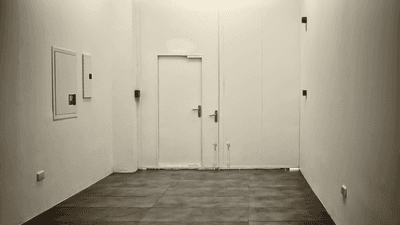
To tackle any preconceptions people held about creaky wardrobes and shadowy underbeds, the team opted instead for the most neutral space they could think of – a circular, featureless room. As luck would have it, a close relative of the research team had just the thing.
We were quite surprised by the high level of anomalous sensations that people reported
Chris French
“We struggled to find an appropriate space to set up the chamber and the kit we were using,” said French. “In the end, we ran the experiment in Usman Haque's Mum's living room. It was very good of her to give up her living room for the weeks it took to run the study!”
The room was dimly lit and kept cool to mimic the conditions of reputedly haunted places, with areas of infrasound and EMF known only to the researchers – two factors that could be switched off so some participants would experience an entirely normal room.
The idea was that this would help isolate any effects of infrasound or EMFs, but as we know from the liminal space phenomenon, even a circular, featureless space can be a little disorienting.
“In retrospect, we wondered if our unusual space might itself be responsible for some of the sensations people reported,” said French. “For example, feeling dizzy, feeling like spinning around.”
Participants were then sent into the room for a period of 50 minutes. Their brief was to mark on a floor map anywhere they experienced anomalous sensations.
Participants were also scored on the Temporal Lobe Signs (TLS) Inventory scale. This asked them to recall past experiences such as déjà vu or other strange sensations typically associated with temporal lobe epilepsy but that also occur in the general population.
The results, says French, were certainly eye-opening.
“We were quite surprised by the high level of anomalous sensations that people reported,” he said. “And we certainly did not anticipate people reporting terror or sexual arousal!”
Spooky, indeed.
Stranger still is the fact that their findings revealed no association between these surprising sensations and the mapped areas of infrasound and EMFs. The answer, it seemed, lay not in the layout of their haunted room but the TLS scores of those who entered into it.
The data revealed that participants with higher TLS scores typically reported more anomalous sensations of various kinds. The researchers therefore concluded that while they could claim some success in building a haunted room, it’s likely that suggestibility was a bigger predictor of spooky sensations than exposure to infrasound and EMF.
And as for those that were getting turned out? Well, that’s a whole other kettle of fish…
Correction: An earlier version of this article listed incorrect dates for the haunted room experiment. This has now been corrected.