Nature
 PUBLISHED
 2
2




In 1998, the International Space Station (ISS) took to the atmosphere. It’s been consistently occupied since November 2, 2000, meaning there have been people living continuously in space for 25 years. Like all good parties, however, it must come to an end.
The aging spacecraft has had its mission extended to 2030, but the following year it's set to retire. Its watery grave will be the oceanic point of inaccessibility, and most remote place on Earth, “Point Nemo”. But where is it, and what’s it like? As luck would have it, we met some folks who have been there.
Where Is Point Nemo?
Point Nemo is the furthest spot from land on planet Earth. Located in the South Pacific Ocean, the nearest land is 2,700 kilometers (1,678 miles) away and represented by three islands: Ducie Island, Motu Nui, and Maher Island. Its location means that the closest humans are periodically those on board the ISS as it flies overhead.
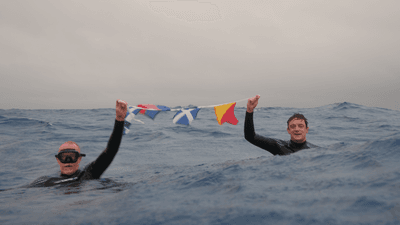
That is, unless a boat comes passing through. Or, as is believed to have only happened on one occasion, a father and son explorer duo decide to go for a dip.
Swimming in the most remote place on Earth
Adventurers Chris and Mika Brown set out on a mission to visit Point Nemo in 2024. The family is familiar with poles of inaccessibility, which on land are the furthest points from the ocean in any direction. Visiting the oceanic pole of inaccessibility meant hopping on board a vessel to journey out to Point Nemo, and to say it was challenging would be quite the understatement.
“The captain said below 40 degrees south, there’s no law,” Mika Brown told IFLScience. “Below 50, there’s no God. You’re just completely exposed. I think Point Nemo was 49, so we were kind of dealing with whatever God wanted to throw at you.”
“The waves were 6 to 8 meters [19.7 to 26.3 feet] high, which is bigger than a house. It’s bigger than your diving board at your local pool, and the swell was 13 seconds. So, every 13 seconds, you’re going down 8 meters and up again, which was awful to be perfectly honest with you. Just awful.”
How deep is the spacecraft cemetery?
By the duo's account, such a journey entails a lot of vomiting, but eventually they found their sea legs and after 10 days they had made it. The water at Point Nemo is around 4 kilometers (2.3 miles) deep, making it a great landing pad for a spacecraft cemetery, but mixed reviews as a swimming spot.
“I don’t like deep water,” said Mika, “so I didn’t put any goggles on. I’m not putting my head in the water.”
“I’m less bothered by the depth,” said Chris, “because 100 meters is just as bad. In fact, at least at 4 kilometers, whatever is down there is further away, but I was expecting it to be black or a really dark green, having seen the Atlantic Ocean. It's a fantastic blue. I was amazed, just looking down, it's almost an iridescent blue. Amazing, very beautiful.”
So, not a spot you’re likely to visit on a whim, which is precisely why it’s favored by NASA as the final resting place for our dear old ISS. But oceanic pole of inaccessibility or not, the scheduled deorbit is sure to make quite a splash in 2031.