Space and Physics
 PUBLISHED
 20
20


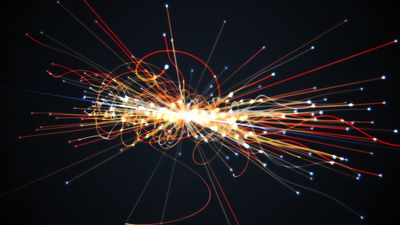


On June 29, after almost 18 years, the Large Hadron Collider (LHC) at CERN was shut down in its current iteration for the last time. When the particle collisions start again in several years, they won’t be happening in the particle accelerator that we know and love, but in its newly upgraded version: the High Luminosity LHC, or more simply, HiLumi.
This is not the first time that the LHC has been turned off in the last two decades. This is, in fact, Long Shutdown-3. CERN’s social media post marking the end of the LHC has clearly confused a bunch of people on social media, with some wild beliefs about what CERN is and what it does.
Our favorite was the comment that simply stated, “CERN has to be real," and we do agree: the European Organization for Nuclear Research (AKA CERN) is very real. We have been there, and you are reading this thanks to one of the things that CERN has gifted the world: the World Wide Web.
A lot of commenters claim they either feel better or worse since the shutdown, or that time is slower or longer. Every single physicist at CERN would probably love to be able to control time, but alas, that’s not what CERN or the LHC can do.
What is the Large Hadron Collider?
The LHC is the most powerful particle accelerator in the world. It is located underground at the CERN border between France and Switzerland and since its construction days has been the target of conspiracy theorists.
The usual claim is that it will destroy the world by producing something weird thanks to particle collisions. Ironically, some natural particle accelerators, like the most active supermassive black holes, can produce particles like KM3-230213A, which had energy 100,000 times higher than the particles we collide in the LHC.
“The Large Hadron Collider is a machine of 27 kilometers [16.8 miles]. It's about 100 meters [328 feet] underground, and it's filled with protons coming from the injector chain,” Rende Steerenberg, who is affectionately known around CERN as "the man who pushes the button to start the LHC", told IFLScience in an exclusive visit to the site.
Before getting to the LHC, those protons have to be accelerated by other smaller accelerators. Powerful magnets push the speed of these particles closer and closer to the speed of light before entering the main ring of the LHC, where they will travel those 27 kilometers at 99.9999991 percent of the speed of light.
“There will be protons circulating in the two opposite directions of the ring, and then these protons are brought into collision at four points of the ring,” Fabiola Gianotti, former director-general of CERN, told IFLScience.
Why was the LHC shut down?
The HiLumi phase is expected to begin in mid-2030, where a portion of the accelerator ring will be changed with new and more powerful magnets, new facilities below and above ground, and improved detectors. The goal is getting a lot more collisions: that’s the luminosity in HiLumi.
“It is an exciting time for CERN: the Long Shutdown 3 will start very soon, and transitioning from the current Large Hadron Collider (LHC) to its massively upgraded version, the High-Luminosity LHC, will bring invigorating possibilities for our research,” Dr Gautier Hamel de Monchenault, CERN Director for Research and Computing, told IFLScience.
“We will be able to maximise the performances of the accelerator, generating more data with the run of High-Luminosity LHC than what we generated with all three runs of the LHC combined.”
What even is Time?
Time is one of the open questions of physics, and as we said above, every physicist at CERN would love to work out what it actually is. Our experience of time, our understanding of time in physics, and what time actually is might be very, very different.
We experience time as something that unavoidably passes, going ever forward. In many physical laws, though, there is no preference for the direction of time. When we experience the so-called "arrow of time", we might be simply seeing the effect of certain physical laws, like, for example, the second law of thermodynamics.
According to this law, in an isolated system (like our universe) left to evolve, entropy – the idea that physical systems increase in randomness, moving from order to disorder – always increases. So the future is always more disordered than the past.
If this wasn’t already a headscratcher, according to Einstein's theory of relativity, time is also not an absolute. It passes differently, depending on your speed and the gravitational pull you experience. Earth’s core is about 2.5 years younger than the surface, and we can now measure the difference in clocks at sea level or up a mountain.
If you were a proton, moving at almost the speed of light in the LHC, then yes, your clock would be different. If you are not, then you have the same time as the rest of us (within a few billionths of a billionth of a second due to altitude differences).