Space and Physics
 PUBLISHED
 5
5


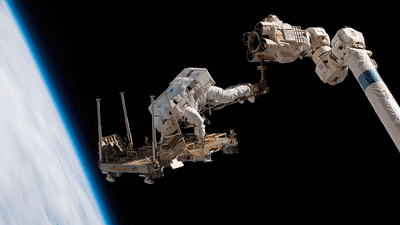


The International Space Station (ISS) has served humanity well, providing scientists with an orbiting microgravity laboratory, and keeping a permanent human presence in space since November 2, 2000.
But all good things must come to an end, and NASA and its international partners are now planning for the end of the space station's operations.
If you've kept up with science news over the last few years it's not difficult to see why, with the aging spacecraft springing plenty of leaks in that time. In short, the ISS was only designed to last for 15 years initially; and now, 26 years later, we are rubbing up against its limits.
Now the countries involved in ISS operations are dealing with the "what goes up must come down" problem. Leave the space station to orbit, without regular nudges from spacecraft sent to it, and its orbit would slowly decay until it came crashing down to Earth.
Rather than letting nature take its course, and the possible risk to people below that that would involve, NASA has commissioned a deorbit vehicle from SpaceX in order to nudge it into Earth's atmosphere in a controlled descent to one of the most remote places on the planet.
Though it is certainly a better option than allowing the space station to crash to Earth alone, it isn't altogether ideal, with The Ocean Foundation worried about the effect the retired station could have on marine ecosystems.
Over on Reddit, meanwhile, people are suggesting an alternative solution: firing the ISS into the Sun.
"This might be dumb question," user amelix34 wrote in the AskAstronomy subreddit, "but why can't we just send ISS into the Sun?"
First off we should say that there are no stupid questions (ok, maybe there are a few), and we certainly admire the poster's evil ambition. After all, what is the point in having a 1.989-nonillion-kilogram star fusing hydrogen into helium at the center of our Solar System if we can't hurl our garbage into it every now and then?
But unfortunately, there are plenty of reasons why our star cannot take care of the "what goes up must come down" situation, the main one being those irritating laws of physics.
"Our planet is traveling very fast – about 67,000 miles per hour – almost entirely sideways relative to the Sun," NASA explains. "The only way to get to the Sun is to cancel that sideways motion."
That is a lot of sideways motion to cancel out, and because of it simply strapping a bunch of spacecraft and having them thrust as hard as they can towards the Sun would result in an embarrassing miss.
"[W]hen our rocket leaves the proximity of the Earth it is travelling faster around the Sun than towards the Sun. At first the rocket gets closer to the Sun. But the motion of the rocket around the Sun and gravity results in an elliptical orbit that misses the Sun entirely," Michael J. I. Brown, Associate Professor in Astronomy at Monash University, explains in a piece for The Conversation.
"It isn't even close: we miss the sun by almost 100 million km."
According to Brown, if we were able to launch a spacecraft at around 7,000 kilometers per second (4,350 miles per second) that would cut it, but bar any major physics breakthroughs in the next few years, the ISS is not getting launched to the Sun in this way.
That isn't to say it's completely impossible in the future. NASA has launched a (far smaller) spacecraft towards the Sun in order to study it, with the Parker Solar Probe using the planet Venus as a decent set of brakes.
"Spacecraft can leverage the gravity of other planets to speed up, like a slingshot, or to slow down, like tapping the brakes," a video from the Johns Hopkins Applied Physics Laboratory explains.
"A planetary gravity assist changes a spacecraft’s heliocentric speed by rotating the direction of the spacecraft’s flyby velocity," they add.
"As Parker Solar Probe speeds towards Venus, it flies in front of the planet to slow down - kind of like swimming against a current. This actually allows the spacecraft to leave a little of its momentum with Venus as it zips by. The flyby alters Parker Solar Probe’s orbit – sometimes by millions of miles, sending it closer to the Sun."
While cool, and necessary for studying the Sun's corona, the Parker Solar Probe (around 685 kg, or 1,510 pounds) is significantly smaller in mass than the ISS (around 419,725 kg, or 925,335 pounds). In short, it would be incredibly expensive in terms of fuel and energy to place the ISS on a long, slow mission involving gravity assists from Venus, placing the idea well out of reach even if the will was there.
Meanwhile, the space station is constantly just on the edge of falling back down to Earth, needing to be nudged or "reboosted" into higher orbit in order to continue operating. It's far easier to let it crash down to Earth, at a controlled time of our choosing, even if it isn't quite as fun as firing the remains into the Sun, or turning it into a museum instead.