Nature
 PUBLISHED


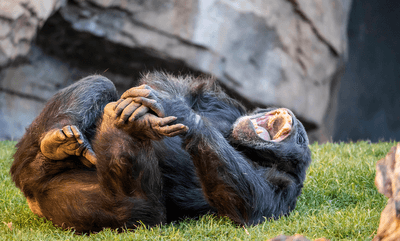


Ever wondered what it’s like to tickle an ape? Turns out, they bloody love it, and lose their minds laughing just like we do.
Yet tickling isn’t all fun and games, and can be serious science too. For instance, researchers have just figured out something pretty cool about the evolution of language in humans, and they did it by tickling some of our closest relatives.
Analyzing the laughter of four orangutans, three bonobos, two gorillas, and four chimpanzees, the study authors found that great apes laugh with an isochronous rhythm, which means that vocal bursts are evenly spaced.
This same characteristic is also present in human laughter, indicating that this particular trait must have emerged in the last common ancestor of humans and the great apes, which lived some 15 million years ago.
“Before conducting the study, I would probably have expected greater irregularity in the laughter of our more distantly related relatives,” explained study author Dr Chiara De Gregorio in an email to IFLScience.
“Instead, the rhythmic regularity of laughter appears to be remarkably conserved across the great apes. This suggests that we’ve been laughing in this way for around 15 million years!”
While we can never know exactly what extinct hominins sounded like, our findings suggest that they likely produced rhythmically regular laughter.
Dr Chiara De Gregorio
However, unlike the apes, humans display an ability to alter the speed of their laughter depending on the social context.
For instance, we tend to laugh faster when we are tickled than we do during play, while chimps, bonobos, orangutans and gorillas maintain more or less the same laughter in all scenarios.
“Across the great apes, laughter appears to have started as a relatively stereotyped rhythmic signal, mainly used in a limited set of social contexts such as play or tickling,” says De Gregorio.
“In humans, however, laughter has become extraordinarily diverse. We can produce everything from a quiet, polite chuckle to a loud, uninhibited laugh, or even an ironic or 'fake' laugh when we want to signal something other than genuine amusement.”
The study authors therefore propose that the rhythmic flexibility of our giggling may act as a proxy for vocal control in general, revealing how we developed the ability to modulate our audible output in sophisticated ways. Such mastery would likely have been fundamental to the emergence of speech and language.
“Of course, laughter is not language, but both rely on the ability to control and modulate vocal output,” says De Gregorio. “In that sense, the evolution of laughter may have gone hand in hand with the evolution of the vocal capacities that ultimately supported speech and language.”
Overall, the researchers found that the ability to modulate laughter exists as a continuum, and is strongest in apes that are most closely related to humans. This suggests that control over vocalizations may have evolved gradually over the last 15 million years, enabling us to speculate over the ways in which Neanderthals and other extinct hominins might have laughed.
“While we can never know exactly what extinct hominins sounded like, our findings suggest that they likely produced rhythmically regular laughter,” says De Gregorio.
“I would expect their laughter to have been intermediate between that of modern humans and that of chimpanzees and bonobos: probably more variable and flexible than in chimpanzees, but less so than in modern humans.”
The study is published in the journal Communications Biology.