Space and Physics
 PUBLISHED


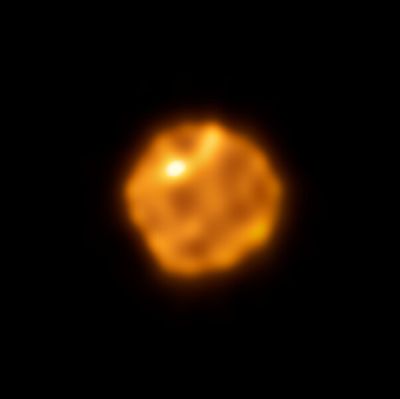


Astronomers have just taken one of the best looks yet at the surface of Betelgeuse, the famous red supergiant star in the constellation Orion. It is incredible we can see so much detail in a star hundreds of light-years away.
The observations reveal how dynamical and oddly shaped this star is, with some surprises. Certain regions seem to have hardly changed in a decade.
Betelgeuse is one of the closest supergiant stars to Earth, and where all our money and hopes lie to see a supernova explosion with our naked eye. This evolved star is an endless source of fascination and an invaluable window on the final stages of stellar evolution.
We often picture stars as well-defined spherical objects, but this is not exactly the case. The Sun is not solid, and its visible surface, the photosphere, has a density of less than 0.05 percent of that of the air at sea level.
Betelgeuse is much heavier than the Sun, about 14 times the mass of our star, but also a lot bigger, with a radius over 650 times that of the Sun. Placed in our Solar System, Betelgeuse would extend far beyond Jupiter’s orbit. It is that big!
The outer layers of the star are a lot less strongly bound compared to the Sun. The star looks lumpy in the observations from the Atacama Large Millimeter/submillimeter Array (ALMA). Similar views were taken by the telescope almost a decade ago, and comparing the two reveals some surprises.
While the average temperature (2,000 degrees Celsius, 3,600 degrees Fahrenheit) is consistent with the models, there are two bright spots hundreds of degrees hotter. Upwelling gas is likely the cause.
These have been found before in previous observations. The fact that they have stuck around challenges the current models. The lifetime of these spots was expected to be much shorter.
“We interpret these as localised energy input from underlying convection cells, with up to 1 percent of the stellar luminosity at this wavelength. Comparison with an observation taken 7 years previously shows little change in this structure, indicating that they are relatively persistent compared with turbulent convection models,” the authors wrote in the paper.
There is an interesting possibility about the extended life that these spots have. And the answer might be in its recently found but long-debated companion Siwarha, or Betelgeuse B. Its orbit around the much larger star might affect the convection.
Researchers also found evidence that not all stellar convection inside this massive star is stable, which would explain how lumpy it looks at the edges.
The study has been accepted for publication in Astronomy & Astrophysics and is available on the arXiv.



 1
1