Humans
 PUBLISHED
 2
2




In a new study, a team of researchers have identified the place you should go to if you wish to avoid global catastrophic risk. Though no country was deemed completely safe from the risks facing humanity today, the team found a few places where the risks are lower, and one clear winner for anyone wishing to escape from it all.
While we don't wish to be doom-mongers, and there is plenty of hope for sorting out the avalanche of crises facing humanity right now if we really get our act together, the world is facing a few, ahem, challenges at the moment.
In concrete terms, the team wanted to study where would be safest to hide from the impacts of nuclear war, near-Earth objects, large-magnitude volcanic eruptions, large-scale cyberattacks, high-altitude electromagnetic pulses, geomagnetic storms, and pandemics.
Which is plenty of problems to be going on with, before you ask why they didn't also include things like the rise of antibiotic resistance.
The team placed the potentially catastrophic scenarios into three categories, and attempted to answer how resilient various countries around the world are to each type of risk.
The first were abrupt sunlight reduction scenarios, where the amount of sunlight reaching the surface is reduced by nuclear winter, volcanic eruptions, or near-Earth objects slamming into our planet.
In this scenario, they suggest that the resilience of nations to face these threats is increased in the Southern Hemisphere, where there are no states with nuclear weapons and fewer volcanoes. As well as this, islands that are self-sufficient in food, and that have longer growing seasons, are less at-risk from these reduced sunlight scenarios.
Reviewing relevant literature, the team found that no country was ideally placed to withstand these sunlight reduction scenarios. Islands, though the best placed to survive, often lacked industrial capacity and relied on trade, whilst being surrounded by oceans is not helpful in scenarios where an asteroid has struck the ocean, causing tsunamis.
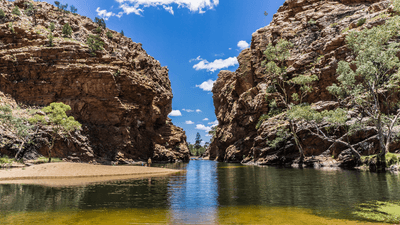
However, in all three scenarios Australia fared the best.
"It is located in the Southern Hemisphere, far away from nuclear conflicts (though it is allied with the US, which might increase risks), it did not experience volcanic eruptions in the Holocene, but a large interior, which people could relocate to if an asteroid strikes (although a large fraction of this is desert)," the team explained in their paper.
"Additionally, it is a major food producer, has diverse climate zones, a long growing season, significant coal and gas infrastructure, large forested areas and a Pacific coastline."
Beyond Australia, the countries of Argentina, Brazil, and New Zealand all fared fairly well, at least compared to all of the Northern Hemisphere.
The next area looked at was global catastrophic infrastructure loss, resulting from scenarios such as giant geomagnetic storms and cyberattacks. Here, resilience is higher in countries that do not rely on complex supply chains, with countries that rely on digital technology for their infrastructure suffering the most.
Areas that rely less on pesticides and fertilizers are more robust in facing infrastructure collapse – it's not a problem if you can't get industrial fertilizer when you don't use industrial fertilizer. The authors suggest that smallhold farmers will fare better, as well as organic farms.
"Regions which currently use few agricultural inputs like fertilizers or pesticides are expected to maintain their current food production levels, even after infrastructure collapse. This is fulfilled by many smallholder farmers globally, but also by alternative kinds of agriculture in more industrialized societies (e.g., organic farming or permaculture)."
In geomagnetic storm scenarios (again, bad news, Northern Hemisphere) it is the Northern Hemisphere that is the most exposed, both because of our location and our reliance on satellites, which may not fare so well in a large geomagnetic storm.
In these scenarios, the team suggests that Australia and New Zealand are the most resilient countries, with a good industrial base and as producers of food. New Zealand is a producer of fertilizer, and as long as the two nations continue to trade the pair could be well-placed to weather out this infrastructure collapse.
The final area looked at was global catastrophic biological risk scenarios, such as a further pandemic.
Unsurprisingly, the countries that fared better here were those with better health systems and supply chains, islands or remote areas, and countries with universal healthcare.
Scandinavia, Canada, and Switzerland fared well for a few of these reasons, though the researchers note that they could be more remote. Australia and New Zealand again fared the best, though as they both rely on trade this was not perfect either.
While Australia, and sometimes with its buddy New Zealand, fared the best across all scenarios, a key takeaway is that nowhere is truly safe from these kinds of large, disruptive scenarios.
"Maintaining trade and cooperation is of utmost importance, which is explicitly highlighted in many studies, especially for smaller countries that are not self-sufficient in key productive sectors (e.g., food, fuel, energy, etc)," the team writes in their discussion.
"Even places like Australia and New Zealand could likely struggle if they were cut off from imports of medicine, fuel and fertilizer. In the globalized world of today, no country can truly stand alone."
The study is published in Global Challenges.