Space and Physics
 PUBLISHED



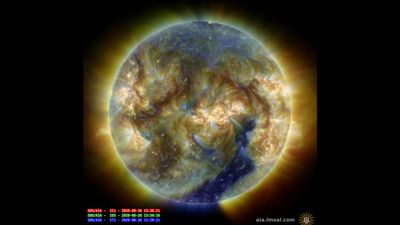


It has been almost two years since our current solar cycle hit peak activity, so it isn't surprising that the Sun has been a bit quieter recently. But we are still several years away from the minimum, so our little star can still pop off with occasional fireworks.
A sizable sunspot called 4513 has released several solar flares over the past two days, in particular yesterday, up to a class M6.89 flare. While not as powerful as the highest-tier X-class flares that occasionally grace the news, it was still sizeable enough to generate radio blackouts across the sun-facing side of the Earth, which at that time was mainly Europe and Africa.
It isn't just the flares, though. The Sun is currently sporting a coronal hole. The solar corona is the extremely hot and complicated atmosphere of the Sun. When holes in this atmosphere form, the solar wind – the stream of charged particles that are always being jettisoned out from the Sun – escapes at a higher speed. This by itself enhances the aurorae. Though something else also happened this time around.
.gif "the central view of the Sun is blocked but wide wisp of plasma are thrown into space")
On top of the high-speed stream from the coronal hole, the Sun also emitted a coronal mass ejection, an eruption of high-speed plasma. Unencumbered by too much coronal material, and flowing in the wake of the high-speed stream, some powerful plasma is going to collide with our planet’s magnetic field and then our atmosphere over the next few days.
Consequently, the Space Weather Prediction Center of the National Oceanic and Atmospheric Administration (NOAA) has issued a geomagnetic storm warning for August 27 and August 28.
The warning level currently in place for August 27 is a G1. At this grade, the lowest one on the scale, power grids may experience weak fluctuations, and some migratory animals might be affected as well as some satellites, according to the Space Weather Prediction Center.
Aurorae might be seen at high latitudes in the contiguous United States (such as northern Michigan and Maine).
On August 28, the warning goes up a notch to G2. At this level, power grids at high latitudes could be affected, per the center, and aurorae might reach as low as the 55th geomagnetic latitude and be visible on the low horizon as far south as New York State and Idaho.
Most of the Northern States might have a chance to see the show, according to the aurora forecast from the Geophysical Institute of the University of Alaska Fairbanks.
This is another reason for amateur astronomers to be very jealous of people in the higher latitudes of North America this week, as not only do they have a chance of seeing the northern lights, but there will also be a partial lunar eclipse.
We look forward to seeing the amazing pictures that will come out of this cosmic coincidence!