Space and Physics
 PUBLISHED



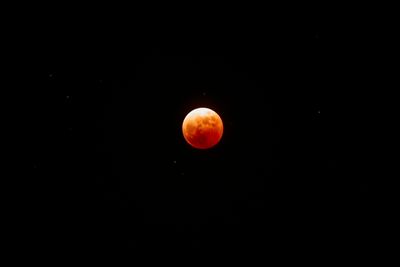


If you are craving a lunar eclipse, the best chance you've got for almost 16 months is this week. While Earth's shadow will cover the Moon almost completely, and it may take on a bit of a red tinge, it won't be enough to form a true "Blood Moon."
Eclipses tend to come in pairs, one solar and one lunar. We had an incredible total solar eclipse, and so it follows that we are now getting a lunar one. Unfortunately, we aren't getting a total lunar eclipse, where the Moon is completely within Earth's shadow.
Our planet's shadow isn't black, and so when we do get total lunar eclipses, they don't make the moon disappear. Instead, because of the way light filters through the atmosphere, Earth's shadow has a slightly red tinge. So, once the Moon is fully in shadow, it appears red, creating what we call a Blood Moon.
Why aren't we getting a total lunar eclipse to pair with our total solar eclipse then? The reason has to do with celestial mechanics.
The orbit of the Moon is slightly slanted with respect to the Earth's orbit around the Sun. If they were on the same plane, we would get a lunar and solar eclipse every month.
Instead, we need to wait for a moment when the Sun, Earth, and the Moon are aligned – or in syzygy – to coincide with either a new moon (for a solar eclipse) or a full moon (for a lunar eclipse). This happens roughly every six months, but it doesn’t mean the alignment is always perfect.
There are partial lunar eclipses, where the Moon doesn’t fully enter the shadow, and penumbral eclipses when the Moon only crosses the half-shadow.
During a partial eclipse, the Moon is never fully in shadow, but if the eclipse is deep enough, there will be a crimson tinge to the mostly eclipsed Moon. While Friday’s eclipse isn't total, it will be 93 percent covered, so we should be seeing some redness.
The best place to see the upcoming partial eclipse of the Moon is the Americas, but most of it will be seen across Africa and Europe as well as in New Zealand and other eastern parts of Oceania.
The eclipse will start at 9:23 pm EDT with its penumbral phase. Ten minutes later, the partial phase begins. It will reach a maximum at 12 minutes past midnight, and then the moon will become more and more visible again. The partial phase ends at 01:51 am, and the penumbral phase is about 70 minutes later.
In 2027, there will be two lunar eclipses – both penumbral, so the Moon will just appear dimmer – and an "almost eclipse" when the Moon is just out of the half-shadow. In 2028, there will be two partial eclipses not as deep as this, though the year will end with a total lunar eclipse visible on December 31.