Space and Physics
 PUBLISHED



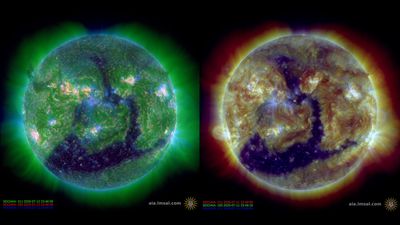


Observations of the Sun last weekend have revealed some stunning features marking the solar disk and beyond. There is a gigantic coronal hole stretching across the surface of the Sun, spewing fast solar wind right at us. And if that were not enough, there’s a dark prominence that looks like some monstrous insect crawling across the edge of the disk.
Despite their stupendous appearances, these features are to be expected on the Sun. This is especially true when we consider that we are still in the more active phase of the solar cycle. We might have passed the peak of it all – the solar maximum – but the Sun is far from reaching its quiet period.
A coronal hole, visible in the images as the dark patch stretching across the surface, is a region of the Sun’s atmosphere – the solar corona – that tends to be cooler than the rest. Given that it reaches millions of degrees, it might not be exactly our idea of cool, but it is all relative in space.
The reason why this region is cooler is how the magnetic field is behaving. Instead of the closed magnetic field usually found in the corona, the hole has open unipolar field lines. This allows the solar wind – the stream of charged particles escaping the Sun – to escape more readily, and often coronal holes lead to an increase in auroral activity.
If the coronal hole seemed peculiar enough, then you are not ready for the weird prominence on the left side of the Sun. Prominences are also magnetic phenomena where the plasma of the Sun’s surface – the photosphere – extends outwards into space. They are often in loops, and while they can form pretty quickly, few end up being stable for months.
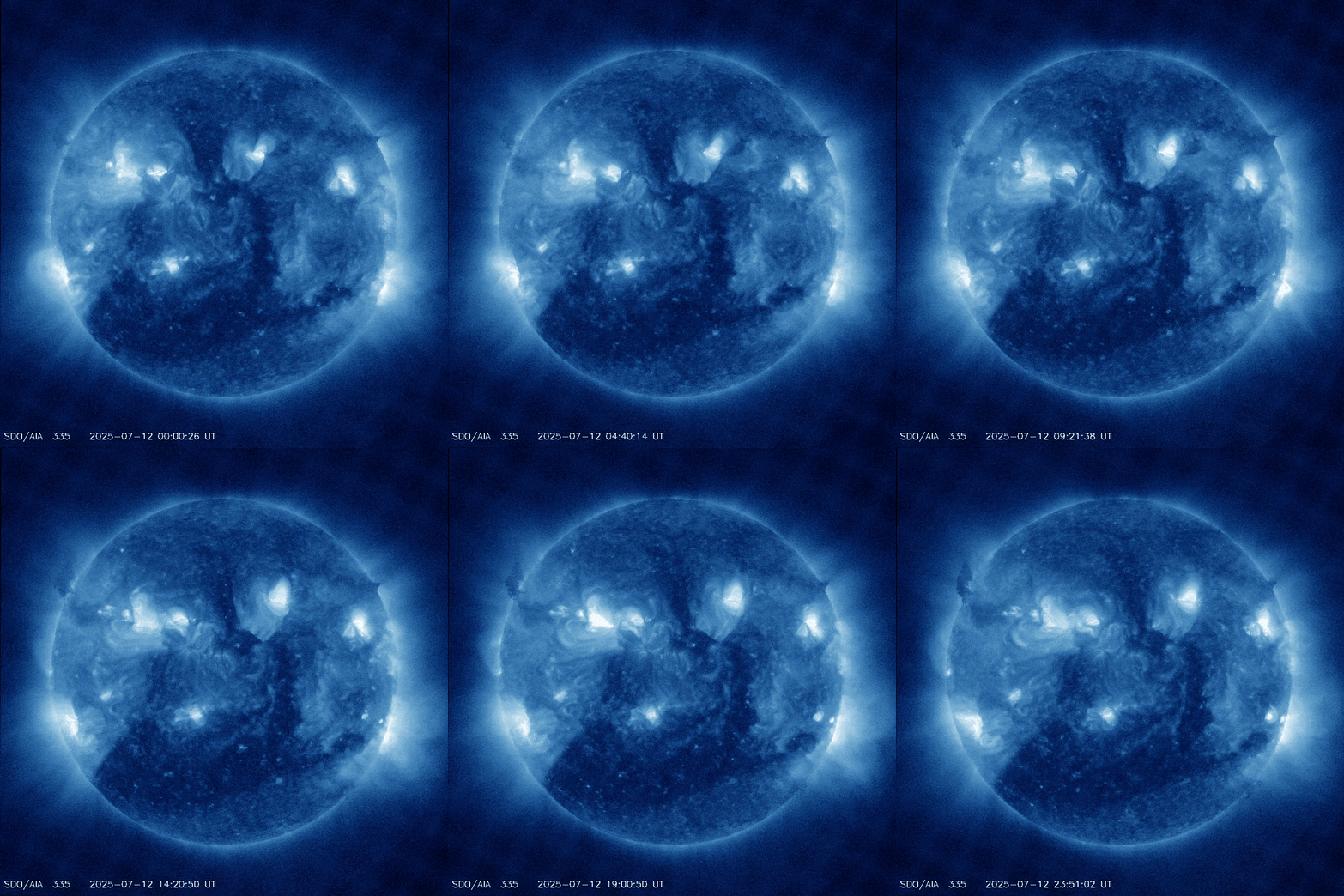
Astrophiles spotted a peculiar prominence stretching on the limb of the Sun on July 11 and it persisted for several days. But the best view is from daily movies of the Sun. As the magnetic fields shift, and the cooler plasma shifts with them, the enormous prominence, stretching for several tens of thousands of kilometers, looks like a bug crawling at the edge of the Sun.
As the structure rotated into view, it kept scuttling. Days later, it looked like it was no longer there, or at least we couldn’t see it – but more coronal holes appeared that will join the big one, which has shifted mostly south. The Sun’s activity is slowly going down, but it will keep us entertained nonetheless.