Space and Physics
 PUBLISHED
 1
1





The northern and southern lights are beautiful electromagnetic phenomena. Electrically charged particles from the Sun slam into the atmosphere, exciting the gas there, producing waving curtains of light. As the Sun is around the peak of activity in its 11-year-long cycle, there is a lot more space weather, with more active aurorae.
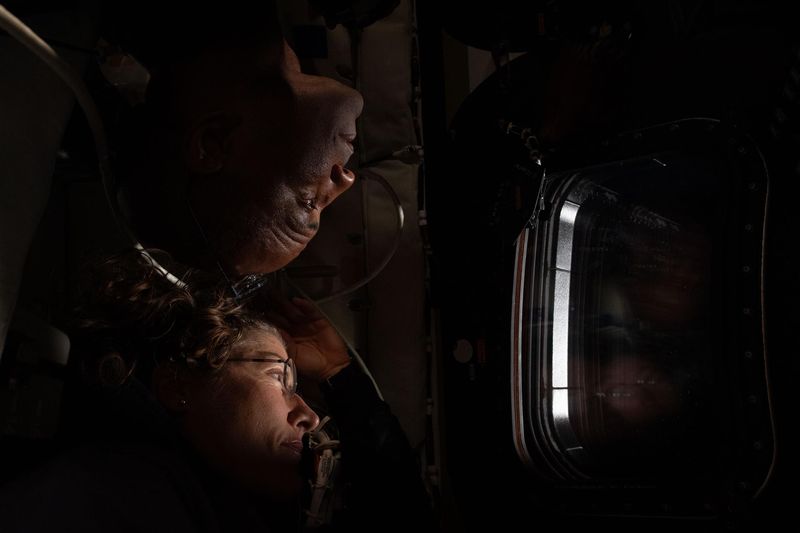
The astronauts onboard the International Space Station (ISS) had a great view of them a few weeks back. While traveling in the portion of the Indian Ocean between Australia and Antarctica, the view from the ISS was breathtaking. At 419 kilometers (260 miles) above the sea, images show the streaks of the aurorae snaking about and wrapping around the planet.
The images come from NASA's image archive Gateway to Astronaut Photography of Earth. They were taken in rapid succession, showing both the subtle changes of the aurorae and the motion of the ISS, which moves through space at around 8 kilometers (5 miles) per second.

The colors of the aurorae are specific to which atoms and molecules are hit by the solar particles and at what altitude. Often, the aurorae are green because that is the color emitted by oxygen, which is easy enough to excite.
It is possible to have other colors, as seen in the pictures. For this to happen, you need particles that are more energetic. Solar storms help with that – in those cases, green lights are accompanied by red ones.

Red aurorae are created in two ways: the first, deeper red is from nitrogen atoms, which can also cause hints of purple, blue, and pink depending on the energy. If the Sun is really active – like it is now – then you can also get red from oxygen. Under certain conditions, you can even get orange aurorae, but that’s due to a combination of the above rather than an actual emission.
If you can’t take a trip to the ISS, there are always the higher latitudes (check the forecast here) or hoping for another solar storm like the one from last May.