Space and Physics
 PUBLISHED



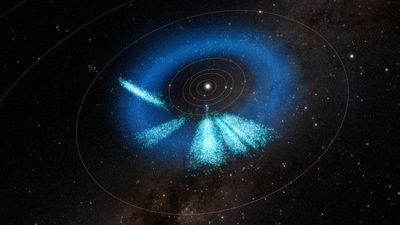


The Vera Rubin Observatory has been getting ready to start its revolutionary 10-year-long survey: the Legacy Survey of Space and Time. Since last year, scientists have been working on the observatory to make sure everything is ready. In the preliminary data collected over six weeks between April and May 2025, Rubin has discovered 11,000 new asteroids.
The data was confirmed by the International Astronomical Union’s Minor Planet Center (MPC). It represents the largest single batch of asteroid detection submitted in the past year. It spotted 11,000 new asteroids, 33 of which are previously unknown near-Earth objects (NEOs), asteroids that have orbital parameters similar to our planet.
None of those NEOs are dangerous to Earth, and the largest is 500 meters across (0.31 miles). While astronomers have found all the civilization-ending NEOs, we have found only 40 percent of those that can create regional devastation – basically larger than 140 meters. Rubin will be a very important tool in that search.
In those six weeks, Rubin has also spotted more than 80,000 known asteroids, including many “lost” ones. These are discovered asteroids whose orbit was not known with high enough accuracy and then were no longer seen at the predicted locations. Thanks to Rubin, they are found once again. By the end of the LSST, the observatory is expected to more than triple the known number of asteroids, adding 3-4 million new ones to the 1.5 million currently known.
“This first large submission after Rubin First Look is just the tip of the iceberg and shows that the observatory is ready,” said Mario Juric, faculty at the University of Washington and Rubin Solar System Lead Scientist, in a statement. “What used to take years or decades to discover, Rubin will unearth in months. We are beginning to deliver on Rubin’s promise to fundamentally reshape our inventory of the Solar System and open the door to discoveries we haven’t yet imagined.”
“Rubin’s unique observing cadence required a whole new software architecture for asteroid discovery,” said Ari Heinze, University of Washington, who, together with Jacob Kurlander, a graduate student at the University of Washington, built the software that detected them. “We built it, and it works. Even with just early, engineering-quality data, Rubin discovered 11,000 asteroids and measured more precise orbits for tens of thousands more. It seems pretty clear this observatory will revolutionize our knowledge of the asteroid belt.”
Rubin possesses the largest digital camera ever created, and it is expected to spot up to 7 million transient events every night. A test showed that it can do 800,000 no problem. This approach can be applied not only to the inner solar system to see asteroids, but also to spot objects beyond the orbit of Neptune.
The observatory has spotted 380 new trans-Neptunian object (TNO) candidates; two of which have an orbit so elongated that at their furthest point from the Sun, they are 1,000 times farther away from the Sun than Earth. Provisionally named 2025 LS2 and 2025 MX348, they are among the 30 most distant minor planets known.
“Searching for a TNO is like searching for a needle in a field of haystacks — out of millions of flickering sources in the sky, teaching a computer to sift through billions of combinations and identify those that are likely to be distant worlds in our Solar System required novel algorithmic approaches,” said Matthew Holman at the Harvard–Smithsonian Center for Astrophysics, who spearheaded the work on the TNO discovery pipeline.
“Objects like these offer a tantalizing probe of the Solar System’s outermost reaches, from telling us how the planets moved early on in the Solar System’s history, to whether a hitherto undiscovered 9th large planet may still be out there,” said Kevin Napier, also at the Harvard-Smithsonian Center for Astrophysics, who, with Holman, developed the algorithms to detect distant Solar System objects with Rubin data
All of this research is available at the Rubin Asteroid Discoveries Dashboard.