Space and Physics
 PUBLISHED



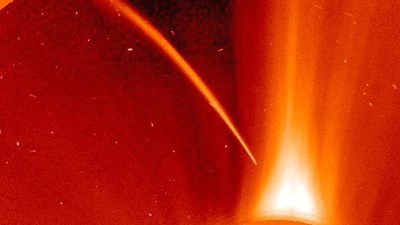


It’s been a while since we've had a Great Comet in the sky, something bright and visible for many. Currently, no object appears to fit the bill for 2026, but a couple of comets have a chance to become bright enough to be visible to the naked eye this April. In fact, a newly discovered Kreutz sungrazer has a very good chance of doing that.
The object is known as C/2026 A1 (MAPS), discovered extremely recently on January 20 by a group of French amateur astronomers using the AMACS1 Observatory in the Atacama Desert, Chile. It has been traced back to the Kreutz comet group, a group that has some of the brightest comets ever seen, like the Great Comet of 1843.
Like other members of this group, it comes from below the plane of the Solar System. It will have its perihelion, its closest approach to the Sun, on April 4. At perihelion, the comet will be just 810,000 kilometers (about 500,000 miles) from our star. In comparison, interstellar comet 3I/ATLAS's perihelion in October 2025 saw it fly around 200 million kilometers (124 million miles) from the Sun.
Sungrazing comets can become very bright for quite a while, or very bright for a very short time, or just get ripped apart. We'll have to wait and see. It is already a record-breaker, however. No inbound Kreutz comet has ever been spotted so far from the Sun with such a long lead-in time (11.5 weeks) before reaching perihelion.
“It's moving on an orbit typical of Kreutz sungrazing comets, and already holds one record. At the time of its discovery, comet MAPS was farther from the Sun than any previous newly discovered sungrazer,” Jonti Horner wrote in The Conversation. “That suggests it might be a larger-than-usual fragment—perhaps.”
The previous record holder was Comet Ikeya–Seki, another Kreutz sungrazer, which passed almost half as close and was so bright it was even visible during the day. It was discovered one month before its perihelion in 1965. It is one of the brightest in a millennium and definitely the brightest of the 20th century. Comet Ikeya-Seki was also very large and still broke apart into three pieces following the encounter with the Sun. This new comet is unlikely to be this large.
Comet MAPS is currently expected to become almost as bright as Venus as it passes by the Sun. That is obviously a very bright comet, but it doesn’t mean it will be a more classical bright comet. Millennials and older folks may remember that in 1996 and 1997, the sky blessed us with two brightly visible comets: Hyakutake and Hale-Bopp. It's unlikely to look like either of them.
In the aftermath of its close encounter, the comet will be visible more favorably in the Southern Hemisphere. It will definitely be visible for solar observatories like SOHO, so we should get some good images.
You might remember we said there were two comets of interest. If Comet MAPS doesn’t pan out, there’s always the chance that Comet C/2025 R3 (PanSTARRS) will be very bright after it reaches perihelion on April 19.