Nature
 PUBLISHED


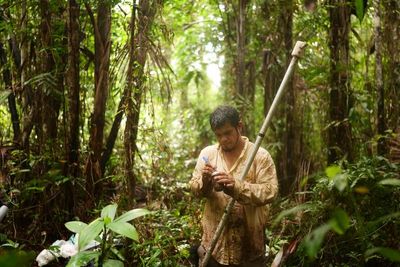


Newly discovered microbes living in the peatlands of the Peruvian Amazon could play a dual role in the carbon cycle. These tiny organisms have the potential to either stabilize carbon for storage or release it into the atmosphere as greenhouse gases.
The archaea were found in the Pastaza-Marañón Foreland Basin, a remote and under-researched region that encompasses approximately 100,000 square kilometers (38,610 square miles) of flooded rainforest and swamps, beneath which lies ancient peat.
These peatlands are among the planet’s largest carbon vaults, estimated to store somewhere around 3.1 billion tons of carbon in their soggy, dense soils. This really is a massive amount; it’s roughly twice the carbon stored in all of the world’s forests.
Peatlands are critical sites for carbon storage, as their waterlogged and low-oxygen conditions slow decomposition so that organic material can accumulate over thousands of years. This process plays a valuable role in regulating greenhouse gas emissions.
Tiny microbes with a big job
Within this saturated soil, researchers from Arizona State University and the National University of the Peruvian Amazon found this never-before-seen family of archaea from metagenome-assembled genomes collected from the area. They have been identified as a family of the Bathyarchaeia class – some of the most abundant microorganisms on the planet – and are uniquely adapted to the waterlogged, low-oxygen conditions of the tropical peatlands of northwestern Peru.
These microbes are hardy things, capable of thriving in extreme conditions due to their flexible metabolism. They can even consume carbon monoxide – a gas that is toxic to many other organisms – and convert it into energy. This process reduces carbon toxicity in the surrounding environment. As they break down carbon compounds, they also release hydrogen and CO2 that other microbes use to generate methane.
"The microbial universe of the Amazon peatlands is vast in space and time, has been hidden by their remote locations, and has been severely under-studied in their local and global contributions, but thanks to local partnerships, we can now visit and study these key ecosystems”, co-author of the study Hinsby Cadillo-Quiroz, a researcher with the Biodesign Center for Fundamental and Applied Microbiomics said in a statement.
“Our work is finding incredible organisms adapted to this environment, and several of them provide unique and important services — from carbon stabilization or recycling to carbon monoxide detoxification and others.”
The newly discovered microbes are brilliantly suited to their environment in the Amazonian soil, where water and oxygen levels fluctuate throughout the year. However, droughts and warming temperatures, as well as the impacts of human activities – including mining and deforestation – are screwing with the delicate balance of this ecosystem. As a result, the peatlands are now releasing greenhouse gases, including methane and CO2, accelerating climate change.
And, if human-caused disruptions continue, around 500 million tons of carbon could be released from peatlands by the end of the century. That’s roughly 5 percent of the world’s annual fossil fuel emissions.
The results of this research show just how important these tropical peatlands are and how much they need to be protected from human activities. That’s why these researchers are advocating for sustainable land management, including reducing deforestation, drainage, and mining activities in the peatlands. At the same time, it is clear more research needs to be conducted into the microbial communities within these environments.
The new study offers valuable new steps toward understanding the critical role of tropical peatlands and their microbial communities in the global carbon cycle. The lessons learned from these little organisms may be vital as climate change continues to progress – the team will continue to investigate them and their progress can be followed here.
“Working to understand microbes and ecosystems in the lush and magnificent Amazon rainforest is the honor of my life, which I aim to use in the protection of this region in the fight against climate change,” Cadillo-Quiroz added.
The paper is published in the journal Microbiology Spectrum.