Nature
 PUBLISHED


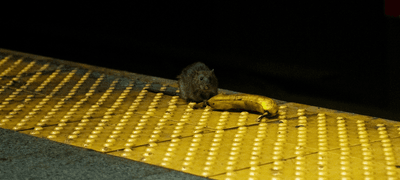


Just like their human neighbors, the rats of New York City have their own distinctive vocalizations, or “accent”, something akin to an urban dialect shaped by the chaos of noisy subways, busy sidewalks, and an abundance of dropped pizza slices. Likewise, these city-slicking rodents have a unique social life that's significantly different from their lab-living counterparts.
In a yet-to-be-peer-reviewed paper, researchers from the nonprofit organization Basis Research Institute set out to explore how living in complex urban environments shapes animal cognition.
And what better place to investigate this phenomenon than Manhattan, the bustling borough at the heart of the city, where roughly 50 rat complaints are received by the city authorities every day?
Brown rats (Rattus norvegicus) have been a nuisance in the settlement since colonial times, and despite multiple “wars on rats” declared over the past century, they continue to thrive with little sign of letting up.
To study them, the team analyzed public data to identify the most rat-infested streets, subway stations, and parks, then deployed sensors to observe the rodents in action. The instruments captured ultrasonic recordings of rat vocalizations and high-resolution thermal imaging of their movement, all of which were processed using artificial intelligence (AI).
The findings showed that the Manhattan rats displayed an “impressive ability to survive in rapidly changing urban environments.” This was most clearly seen in their ultrasonic squeaks and squeals. The team noted that NYC rats have vocalizations that are consistently shorter in duration and have a different frequency from those raised in lab conditions.
Vocalizations at 22 and 50 kHz are typically seen in stressful or unpleasant conditions, but NYC rats squeal at these frequencies in a diverse range of conditions, many of which do not seem aversive or negative.
“For example, a long bout of near-22 kHz USVs [ultrasonic vocalizations] was emitted while a single rat foraged inside of a trash bag. Rats have not been reported to emit 22 kHz vocalizations while foraging in laboratory settings; instead, studies have shown that 22 kHz calls actually suppress feeding behavior. An alternative theory postulates that 22kHz calls could serve a security function — that is, to signal a potential threat (though unperceived) in unpredictable environments,” the paper reads.
To put it another way, the city rats appear to have a slightly different system of communication from the lab rats. What might sound like similar squeaks to human ears can carry entirely different meanings depending on the context of the surrounding environment.
The changes to New York’s rodents run deep. Another paper in 2020 highlighted how the city’s rat population has accumulated dozens of genes that differ from those in ancestral rats. Many of these gene variations were associated with diet, behavior, and movement, and were found to have become fixed within the local rat population.
Perhaps it’s no surprise, then, that New York’s rats have not only genetically adapted to the city’s physical landscape, but also developed their own cultural quirks. Other skills that allow them to navigate big city life include the ability to drive and to dream of traveling elsewhere.
The paper is available to read on the pre-print server bioRxiv.