Nature
 PUBLISHED
 7
7


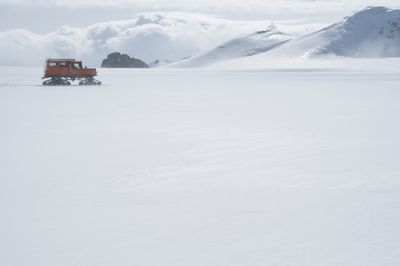


New research has uncovered a “worrying” way that large ice sheets can melt through warm seawater lapping against the underside of ground-based ice. The researchers believe the discovery might even be a new "climate tipping point" – a critical threshold that, when crossed, leads to runaway changes and totally upends an element in Earth's system.
The effect was recently identified by scientists at the British Antarctic Survey (BAS), building on previous research that has shown warm ocean water can sneak large distances beneath ice sheets.
The new study examines how seawater can infiltrate the space between the land and the overlying ice sheet that rests on it, causing localized ice melting. This process lubricates the ice bed and influences the rate at which the ice could slide toward the sea, leading to further trouble.
“Ice sheets are very sensitive to melting in their grounding zones. We find that grounding zone melting displays a ‘tipping point-like’ behaviour, where a very small change in ocean temperature can cause a very big increase in grounding zone melting, which would lead to a very big change in flow of the ice above it,” Alex Bradley, lead study author and ice dynamics researcher at BAS, said in a statement.
Antarctica's ice was once thought to be relatively stable, at least compared to its polar counterpart in the Northern Hemisphere, the Arctic. Between 1978 and 2015, while Arctic ice was melting away, the extent of Antarctic sea ice increased slowly and steadily.
However, Antarctica's ice extent has suffered a notable decline in recent years. In 2017, Antarctic sea ice crashed to a record low, followed by several years of relatively low sea ice extent. More bad news came in 2022 and – most significantly – in 2023 when it reached a new record low.
The researchers of this latest study say that this newly appreciated means of melting could offer a more accurate (and perhaps more damning) picture of how Antarctica and Greenland will change in the face of climate change.
“We have identified the possibility of a new tipping point in Antarctic ice sheet melting. This means our projections of sea level rise might be significant underestimates,” explained Bradley.
“This is missing physics, which isn't in our ice sheet models. They don't have the ability to simulate melting beneath grounded ice, which we think is happening. We're working on putting that into our models now,” he added.
The new study is published in the journal Nature Geoscience.