Nature
 PUBLISHED
 2
2


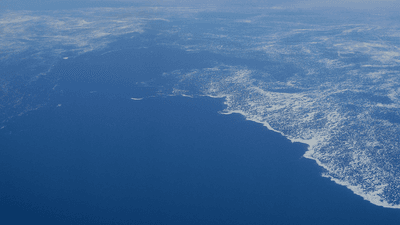


A microcontinent has been discovered in the Davis Strait between Canada's southeastern Baffin Island and southwestern Greenland. In a new study, researchers from the UK and Sweden mapped the microcontinent using gravity data, and seismic reflection data to create a plate tectonic reconstruction of the region.
Though the geology of the region has been extensively studied beforehand, a few mysteries remained.
"A prolonged period of rifting and seafloor spreading between Greenland and North America formed the Labrador Sea and Baffin Bay oceanic basins, connected by the Davis Strait," the team explains in their paper. "However, disagreement exists regarding the exact plate motions between Greenland and Canada, as well as the tectonic evolution of the Davis Strait, with previous models unable to explain the origin of anomalously thick continental crust within the seaway."
While reconstructing the area's past as Greenland separated from Canada, the team found the anomalously thick crust is in fact its own microcontinent; a tectonic block that became detached from a continent, and is surrounded by thinner oceanic crust.
"The reinterpretation of seismic reflection data offshore West Greenland, along with a newly compiled crustal thickness model, identifies an isolated terrane of relatively thick (19–24 km [12-15 miles]) continental crust that was separated from Greenland during a newly recognised phase of E-W extension along West Greenland’s margin," the team wrote. "We interpret this continental block as an incompletely rifted microcontinent, which we term the Davis Strait proto-microcontinent."
The researchers believe that rifting – where tectonic plates split in two – began around 118 million years ago, before continental breakup occurred around 61.27 million years ago in the Labrador Sea. The continents continued to drift apart, before Greenland collided with and joined the North American plate. It was during this time that the new microcontinent was created.
"As our seismic reflection interpretations indicate an extensional event in the eastern Davis Strait between 58 and 49 Myr, spatially coincident with the zone of thinnest continental crust between the continental fragment and Greenland, we infer this extensional event led to the separation of this fragment from Greenland."
The team hopes that the research could help us better understand plate tectonics, and the hazards they can cause to Earth's inhabitants.
"Overall, this work not only recognises several new first order tectonic features of the Earth, the Pre-UTM and Davis Strait proto-microcontinent, but also points to a strong lithospheric control on plate motion directions," the team concludes. "It is therefore fundamentally important to further study this phenomenon to understand the operation of plate tectonics on our planet."
The study is published in Gondwana Research.