Humans
 PUBLISHED

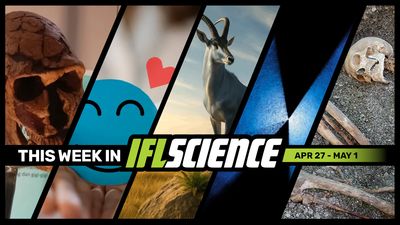


This week, for the first time, we now have a scientific definition for the term “wellbeing”, the largest 3D map of the universe is now complete with over 47 million galaxies and quasars, and AI has recreated the tragic final moments of a Pompeii victim who tried to escape using a terracotta “shield”. Finally, we speak to author Dr Hannah Critchlow on cognition, creativity, and her new book, The 21st Century Brain.
Create an IFLScience account to get all the biggest science news delivered straight to your inbox every Wednesday and Saturday.
Neanderthals Didn’t Go Extinct Because Of Their Intelligence – They Were Likely Just As Smart As Us
The last Neanderthals lived in Western Europe but disappeared within a few thousand years of the arrival of modern humans. The fact that we so rapidly replaced these archaic hominins has been used to support the theory that our superior cognitive abilities allowed us to outcompete them, yet new research shatters this idea by suggesting that Neanderthals were in fact just as brainy as we are. Read the full story here
“The Plan Is Definitely To Make A Living, Breathing Bluebuck”: Colossal Biosciences Announces The South African Bluebuck As 6th Species On Its De-Extinction List
Colossal Biosciences has announced the latest species joining its de-extinction roster. Adding to the already impressive list of woolly mammoth, dodo, moa, thylacine, and dire wolf is the bluebuck, an antelope species that went extinct around 1800. We spoke to CEO Ben Lamm and Chief Animal Officer Matt James about how, and, importantly, why. Read the full story here
People Love To Throw Around The Term “Wellbeing” – Now, For The First Time, We Have A Scientific Definition
Wellbeing: what does it mean? It’s a word we hear a lot, one of those fuzzy concepts we understand but would struggle to define. Well, struggle no more! Scientists from across 11 different disciplines have come together to draft the first-ever international consensus definition of what it means to be well, and there were six factors that really stood out. Read the full story here
With Over 47 Million Galaxies And Quasars, The Largest 3D Map Of The Universe Is Now Complete
The Dark Energy Spectroscopic Instrument (DESI) has achieved its goal. Every single area of the sky that the collaboration set out to map has been mapped, and slightly ahead of its five-year target. DESI was set to gather data on 34 million galaxies and quasars. The final tally of the survey was 47 million galaxies and quasars, the largest high-resolution 3D map of the Universe ever assembled. The ultimate goal is to understand dark energy. Read the full story here
AI Recreates Tragic Final Moments Of Pompeii Victim Who Tried To Escape Disaster Using A Terracotta "Shield"
There’s more than one way to die in agony when you’re caught in the path of a volcanic eruption – as highlighted by the recent discovery of two bodies near the ancient city of Pompeii. Despite meeting their respective ends just a couple of hours apart, these two unfortunate souls were sent to the afterlife in very different circumstances. Read the full story here
TWIS is published weekly on our Linkedin page, join us there for even more content.
Feature of the week:
The Human Brain Vs. A 21st Century World: Dr Hannah Critchlow On Cognition, Creativity, And “That Incredible Organ On The Top Of Our Head”
Your brain is an astonishing thing. Yes, I admit to being slightly biased – I defy anyone to study neuroscience and not come away with that opinion! – but it really is. It has 86 billion neurons, all linked up via trillions of connections, and scores of other cells too. It handles more information every day than we can even conceptualize and somehow makes sense of our environments for us. It’s where our decisions and dreams are born. Yet all too often, we take it for granted. I spoke to neuroscientist and author of The 21st Century Brain, Dr Hannah Critchlow, about some of the challenges that modern life throws at the human brain and how we might better overcome them. Read the full story here
More content:
Have you seen our e-magazine, CURIOUS? Issue 45, April 2026, is available now. This month, we asked, “How Do We Know That The Earth Has A Tilt?” – check it out for exclusive interviews, book excerpts, long reads, and more.
PLUS, the We Have Questions podcast – an audio version of our coveted CURIOUS e-magazine column – continues. In episode 20, we ask, “Can You Learn To Roll Your Rs?”
Our Break It Down podcast now has a new monthly format, coming at you in both audio and visual. So tune in each month to hear about some of the wildest science stories and adventures we’ve been on. Kick off this month with “Artemis II Records, Neanderthal Not-Hybrids, And Introducing ‘Moon Joy’”
The Big Questions season 6 returns in June 2026, so here's our season 5 bonus episode to tide you over until then: Can Magic Be Used As A Tool In Science? You can catch up on the whole of season 5 here.