Humans
 PUBLISHED




There’s more than one way to die in agony when you’re caught in the path of a volcanic eruption – as highlighted by the recent discovery of two bodies near the ancient city of Pompeii. Despite meeting their respective ends just a couple of hours apart, these two unfortunate souls were sent to the afterlife in very different circumstances.
Discovered near the Porta Stabia necropolis, just outside the walls of Pompeii, the pair are thought to have died on the morning of August 25, 79 CE – the second day of the eruption of Vesuvius – while attempting to flee to the coast. The first of these victims was found in a layer of ash above the volcanic lapilli deposits, and is therefore likely to have perished after being caught up in a current of toxic gases known as a pyroclastic flow.
Standing at 166 centimeters tall (5 feet 5 inches), this young man is estimated to have been between the ages of 18 and 20 at the time of his death.
Buried slightly deeper, archaeologists found the skeleton of a slightly shorter man, aged between his late 20s and mid-30s. This individual was discovered within the layer of volcanic lapilli – fragments of molten lava and solid rock – that rained down on Pompeii as the catastrophe unfolded.
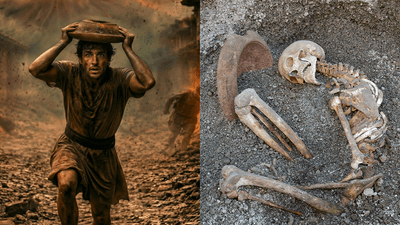
Tellingly, this second victim died holding a terracotta mortar, which he was probably using as a protective shield from this cascade of fiery lapilli. The fact that the mortar is fractured, however, suggests that it may not have withstood the onslaught, and the man probably died under a deluge of burning volcanic ejecta.
.jpg "Skeleton of man who died at Pompeii")
Based on the depth of each skeleton within the built-up sediment, researchers estimate that the older man expired between the hours of five and six o’clock, while the younger man died about two hours later that same morning. Due to the poor visibility caused by the volcanic cloud and the fact that the sun had not yet risen, the earlier victim was also carrying an oil lamp at the time of his death.
On the little finger of his left hand, the man wore an iron ring, while a stash of 10 bronze coins was also found alongside the body. Using a combination of artificial intelligence and photo editing techniques, archaeologists have recreated the final moments of this individual, incorporating all of the data recovered from the site of the discovery.
The image shows the man holding the mortar above his head as he flees in the early morning darkness. According to historical reports, he wasn’t the only one to attempt such an escape, with Pliny the Younger – who observed the disaster from across the Bay of Naples – describing how people held pillows above their heads as they ran for the beach at Stabiae.
.jpg "An AI recreation of the eruption of Vesuvius.")
"The vastness of archaeological data at Pompeii and beyond is now such that only with the help of artificial intelligence will we be able to adequately protect and enhance it," said Gabriel Zuchtriegel, director general of the Pompeii Archaeological Park, in a statement. “If used well, AI can contribute to a renewal of classical studies, narrating the classical world in a more immersive way,” he added.
In this case, at least, AI has brought to life one of the most terrifying moments of antiquity in all its visceral horror.