Space and Physics
 PUBLISHED


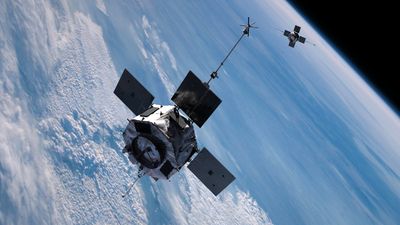


It was not expected to happen for almost another decade, but NASA has confirmed one of the two Van Allen probes is crashing back down to Earth today. The mission revolutionized our understanding of the Van Allen belts, the bands of radiation around our planet. Now, six years after they stopped working, they are coming down to Earth. The first one will drop today, plus or minus several hours, in an uncontrolled reentry.
Uncontrolled reentry means it is not tracked or planned; however, NASA said on Monday, "The risk of harm coming to anyone on Earth is low — approximately 1 in 4,200." The agency expects most of the 600-kilogram (1,323-pound) spacecraft – which is the same weight as an adult male polar bear – to burn on reentry but some components may survive, and we may see them. However, as Earth's surface is 70 percent water, the likelihood of it coming down over land, let alone an inhabited area is low.
Having one of these spacecraft come down to Earth today was a bit unexpected. The probes were launched in 2012 and continued to collect data until 2019, when they ran out of fuel and could no longer orient themselves toward the Sun. When the mission ended, it was calculated that it would take until 2034 for these spacecraft’s orbits to decay due to the extremely tenuous atmosphere, which slowly but surely slows them down. But both of them have been slowed down more than expected, and it’s the Sun’s fault.
The Sun goes through an 11-year-long cycle of activity. Solar Cycle 24, which ended in 2019 when the mission ended, was actually a lot quieter than average, something that might actually be due to changes deep into our star. The current one, Solar Cycle 25, is a lot more active, and the solar activity heats up the higher atmosphere more, making it expand. More molecules mean more drag, and so spacecraft around the Earth drop altitude faster.
The first one of the two, Van Allen Probe A, is now coming down any moment. NASA's prediction puts the reentering at 7:45 pm EDT (11:45 pm UTC) on March 10, 2026, with an uncertainty of about 24 hours. Updated predictions will be given by NASA and the US Space Force, and can be followed on space-track.org.
The Van Allen belts were discovered in the 1950s. The Earth’s magnetic field traps energetic charged particles – mostly from the Sun but also some cosmic rays – into two specific regions, the belts.
The shape of the belts is not fixed but varies in response to the interactions between the Sun and the Earth. Simplistically, they are shown as two concentric donuts: a small stable one, between 1,000 and 6,000 kilometers (600 and 3,700 miles) above the Earth's surface, and a larger, less constant one between 13,000 and 60,000 kilometers (8,100 and 37,300 miles) away.
The Van Allen Probes traveled in an elliptical orbit across both of them, getting as close as 618 kilometers (384 miles) to Earth and as far as 30,415 kilometers (18,900 miles). The closest point to Earth got closer and closer over time, and for Van Allen Probe A, today, is the end of the line.