Space and Physics
 PUBLISHED



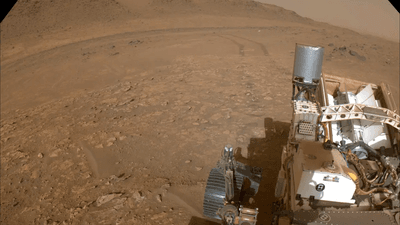


NASA’s Perseverance is a marvelous rover, the most advanced deployed by humanity on another planet. It already had plenty of autonomous capabilities, which had allowed it to navigate the difficult Martian terrain over the last five years. However, a double test conducted in December has shown that its automatic abilities have leveled up, carrying out the first artificial intelligence (AI) planned route on another world.
NASA used a vision-language model, a type of generative AI that uses previously collected data at the Jet Propulsion Laboratory (JPL), to work out what was the safest path. The AI used satellite data from the HiRISE (High Resolution Imaging Science Experiment) camera on NASA’s Mars Reconnaissance Orbiter. Thanks to the training from the existing data and the observations from orbit, the AI was able to find important features like bedrocks and outcrops, but also hazards, such as boulder fields and sand banks.
The computer software created paths just like human drivers would, placing virtual waypoints that the rover had to follow. On December 8, the rover drove that path by itself for 210 meters (689 feet). It then carried out another drive planned by the generative AI on December 10, this time driving 246 meters (807 feet).
“The fundamental elements of generative AI are showing a lot of promise in streamlining the pillars of autonomous navigation for off-planet driving: perception (seeing the rocks and ripples), localization (knowing where we are), and planning and control (deciding and executing the safest path),” Vandi Verma, a space roboticist at JPL and a member of the Perseverance engineering team, said in a statement.
“We are moving towards a day where generative AI and other smart tools will help our surface rovers handle kilometer-scale drives while minimizing operator workload, and flag interesting surface features for our science team by scouring huge volumes of rover images.”
While generative AI driving is a new approach, Perseverance has been able to use its autonomous systems to navigate any unexpected obstacles along its path, like no other rover. It performs dozens of checks multiple times per second to make sure the rover stays safe.
“It's a great engineering achievement to have our latest Mars rover able to drive itself quickly enough that self-driving is now the primary way we accomplish long drives. In fact, over 90% of all driving on Perseverance is now being done autonomously,” Mark Maimone, a long-time rover driver and mobility engineer at JPL, previously told IFLScience.
Human drivers remain fundamental, but ultimately they are several light-minutes away. Mars is, after all, on average, 225 million kilometers (140 million miles) away. The ability to autonomously respond in real time is very important for the robotic explorers.
“Imagine intelligent systems not only on the ground at Earth, but also in edge applications in our rovers, helicopters, drones, and other surface elements trained with the collective wisdom of our NASA engineers, scientists, and astronauts,” said Matt Wallace, manager of JPL’s Exploration Systems Office. “That is the game-changing technology we need to establish the infrastructure and systems required for a permanent human presence on the Moon and take the U.S. to Mars and beyond."