


 Space and Physics
 PUBLISHED


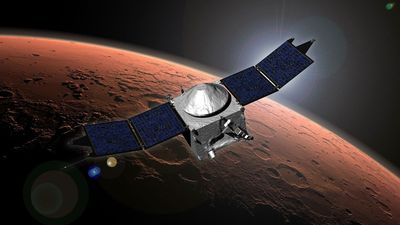


This week NASA confirmed that they could not reestablish contact with MAVEN, bringing the Mars Atmosphere and Volatile EvolutioN mission to a close after 11 years. The space agency had lost contact with MAVEN last December, and the spacecraft is believed to be unrecoverable. That said, it is still orbiting the Red Planet, and it will do so for decades to come.
The exact dynamics of what happened are still under investigation. MAVEN went behind the planet, reporting everything was going well, and by the time it came out from the occultation, something was very wrong.
The team was able to establish that the spacecraft was spinning faster than it should have been; attempts to straighten itself might have led to drained batteries and its inability to reestablish contact with Earth.
Another peculiar thing at the time was that it didn’t look like it was in its orbit anymore. Observations from NASA’s Curiosity rover on the ground in the days following the mishap couldn’t spot it. Now, the team has confirmed that the spacecraft is still in a very similar orbit to its original one, which dictates the fate of the spacecraft. It’s going to burn up in the Martian atmosphere in the next 50-100 years.
“The spacecraft is basically in the same orbit that it was operating in, and it will continue to be there. The nominal plan for disposing of the spacecraft at the end of its mission was just to leave it in that nominal orbit where it would remain for a period of 50 to 100 years before entering the Martian atmosphere,” Shannon Curry, MAVEN’s principal investigator, said during a recent press conference.
The spacecraft gets as close as 180 kilometers (110 miles) from Mars and as far as 4,500 (2,800). Mars’s atmosphere is much more tenuous than Earth’s own. At 180 kilometers, it is extremely rarefied, but there are plenty of molecules that will slowly slow down the spacecraft, shortening the lowest point, until MAVEN comes down onto Mars, joining the Red Planet's spacecraft graveyard.
Where’s the biggest spacecraft graveyard in the solar system?
Disposing of spacecraft, landers, and rovers is an important consideration when designing a space mission. Sometimes, planets themselves help. To avoid a possible contamination of icy moons, missions to Jupiter and Saturn were sent burning into the gas giants’ atmospheres.
In many other places, we simply littered. If we ignore the orbits around Earth, which are filled with defunct satellites (and at one point also a camera and a spatula), the next most polluted object is the Moon, with now well over 70 objects calling it their final resting place after successful and unsuccessful missions there.
On Mars, the number is significantly lower, with 15 defunct landers and rovers, including the Ingenuity helicopter, rovers Spirit and Opportunity, the InSight lander, and China's Zhurong rover.
Some slammed into the planet while others worked very well before eventually losing the battle against the Martian conditions. There’s also a bunch of spacecraft that no longer work, and they, like MAVEN, will remain in orbit for a long while.
Venus also has quite the graveyard of spacecraft, most likely beating Mars in terms of destruction power. There have been 12 missions that successfully landed on Venus, plus many atmospheric probes, and several spacecraft that went into fiery deorbit without having to wait for decades, like in the case of Mars.
In fact, it may turn out seven of those probes actually survived and we called time of death too early.
Perhaps in the future, someone will put the broken robots of the Moon and Mars' graveyards in a nice museum. The stuff left on Venus, with its lead-melting temperatures and crushing pressure, is probably not worth collecting.



 1
1