Space and Physics
 PUBLISHED


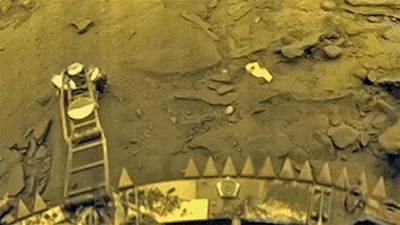


Between 1961 and 1984, the Soviet Union launched 18 probes to Venus as part of the Venera and Vega space programs. Of these, 10 probes would successfully land on the surface of the hottest planet in the Solar System, where a few of them were able to function long enough to send back data and even images, giving humanity the first ever images taken on the surfaces of another planet.
Temperatures, thanks to Venus's thick atmosphere, are hotter even than on Mercury. At the surface, temperatures are thought to reach around 467 °C (872 °F), which is hot enough to melt lead. Though a few probes were able to function long enough to send back data, the one that functioned the longest lasted around two hours before giving up the ghost, and it was presumed that their physical presence would soon be erased from the planet not too long after their functionality was fried, with the help of a crushing atmosphere full of chemically-reactive gases.
"Additionally, the Venusian environment includes active surface processes such as volcanic, seismic, and mass‐movement events," the authors of a new paper explain. "For these reasons, it is commonly assumed that Venus's surface environment would rapidly erase anthropogenic material remains."
But, according to that new paper looking at the geological and atmospheric conditions met by the probes on their arrival, we might have called time of death decades earlier than necessary. Some of the probes may even have survived until today. As well as providing an archaeological record of humanity's first journeys to other planets, if the Venus probes remain unobliterated, they could be useful objects for studying weathering on other worlds.
The first of the Soviet probes launched to the planet were at a significant disadvantage, survival-wise. Venera 3, 4, 5, 6, 7, and 8 were launched when the scientific consensus was that Venus was not too unlike Earth, possibly even having oceans of water on its surface. Venera 3 was even designed in order to make a potential splashdown. As the first four of these probes revealed – particularly Venera 4, which sent back information on the planet's atmosphere – it is far more hellish than that.
At the surface, pressures reach around 92 times the pressure at Earth sea-level, meaning that any object that parachuted down onto it will have around 612 kilograms (1,350 pounds) of pressure pushing on every square inch of it. These early probes were sent to the planet with bodies designed to degrade as they fell through Venus's atmosphere, and were not reinforced enough to withstand it.
"Consequently, none of these early landers survived to the surface in working condition as all were depressurized, deformed, and effectively 'cooked' by the extreme temperature and pressure," the team explains. "Nonetheless, because of the strong aerodynamic braking provided by Venus's dense atmosphere, which prevents high‐velocity impacts, the deformed metallic remains of both the landers and their heat‐ shield shells are still likely present on the surface, even in cases where parachute failure resulted in a free‐fall descent."
Looking at later probes – which were better equipped to handle the extreme conditions on Venus, now that we knew what they were – as well as the geology of the areas that they are thought to have landed, the team believes that seven probes from the Soviet Union and the USA's NASA have a higher chance of having survived to this day. As well as this, they should still be visible at the surface, even if they may be a little deformed by their journey, and the weight of the carbon dioxide-rich atmosphere pressing down on them all this time.
One major source of potential damage to the spacecraft, including NASA's Pioneer Venus Day and Night probes, is the supercritical carbon dioxide that begins around 12 kilometers (7.5 miles) above the planet's surface. In this phase, it has "liquid-like" behavior, allowing it to make its way into tiny holes in the probes, where it would act like a solvent.
As well as this, there is the possibility of the probes being buried by geological processes, and we do not have enough data to rule out this occurring to the probes. Nevertheless, the team believes that there is a good chance that the Venera 5, 6, 7, and 10, VeGa 1 and 2, and the Pioneer Venus Night Probes have been preserved on the planet.
"Contrary to the widespread assumption that Venus's extreme surface environment would rapidly erase anthropogenic material traces, the results of this qualitative analysis lead us to demonstrate that Venusian space heritage may exhibit a high potential for long‐term preservation," the team concludes, adding, "In sites where such geological activity is absent, more likely for archeological contexts located within Venus's extensive lowland plains, Venusian landers are expected to remain largely preserved and clearly identifiable on the surface by future missions, thanks to the extremely slow and weak sedimentation processes operating on the planet."
Further missions to the planet would be necessary to confirm this, but it's an exciting possibility that these first missions of humanity to a whole new world may be preserved on its surface.
The study is published in Geoarchaeology.