Nature
 PUBLISHED
 1
1




NASA satellites have captured images of a giant, glowing blue-green bloom forming off the coast of New Jersey, Delaware, Maryland, and Virginia in the USA.
Starting in mid-April, NASA's Earth-facing satellites began to see the swirling patterns of blue, green, and brown waters emerging in the shallow coastline. In an image captured by the Moderate Resolution Imaging Spectroradiometer (MODIS) instrument on board NASA's water-monitoring Aqua satellite on May 3, the bloom had grown to a truly massive scale.
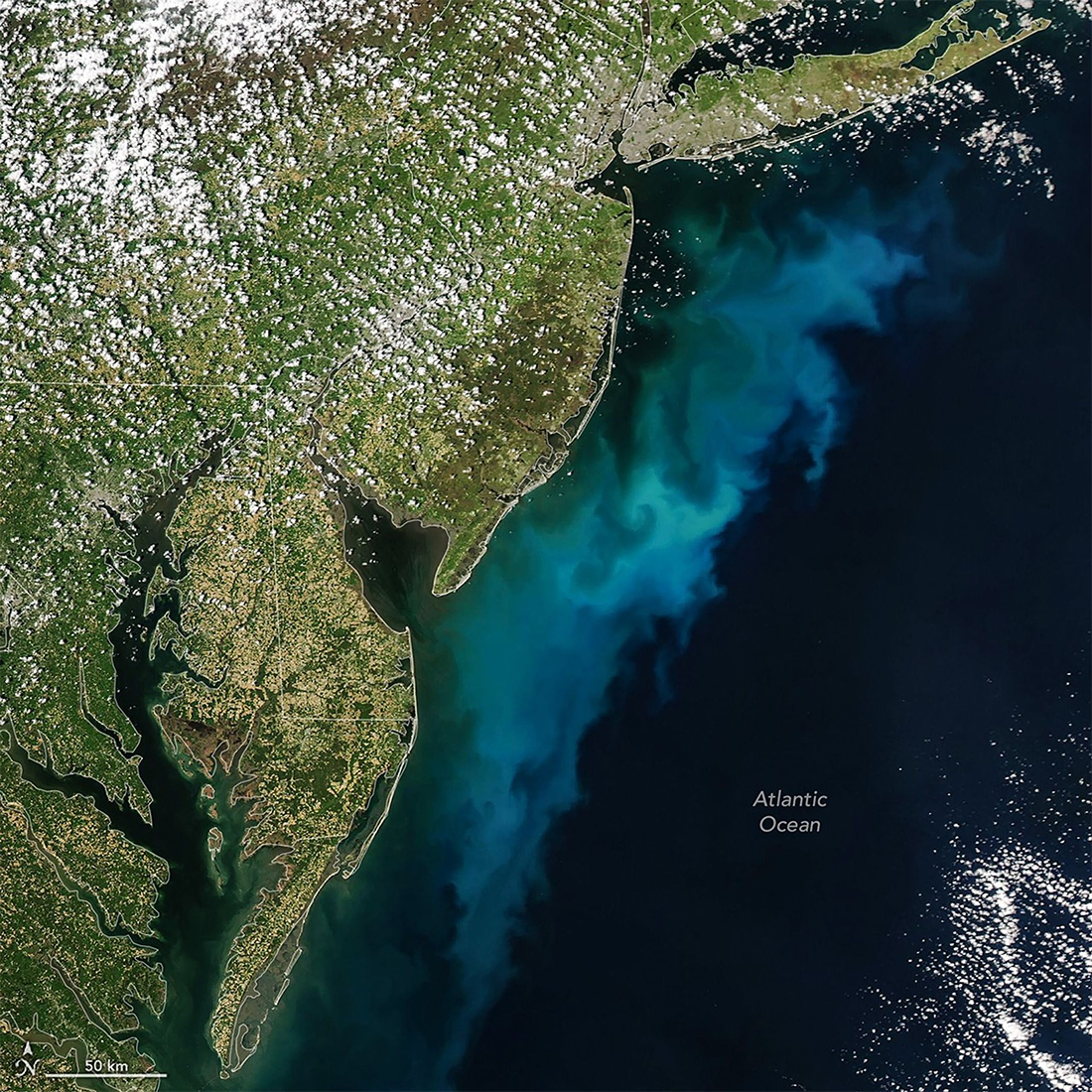
So, what exactly is it? According to NASA, part of the color seen in the images is down to outflows from rivers, as well as spring storms churning up the sediment. However, the rest is likely down to a vast collection of microscopic living organisms.
"Many types of algae, including cyanobacteria, dinoflagellates and diatoms, can generate massive populations with densities greater than 15,000,000 cells per liter, stretching for hundreds or even thousands of square kilometers in water bodies," Kyle Scotese explains for the International Society for Diatom Research. "These blooms can proliferate and dieback in a matter of days or return seasonally for decades."
With the launch of NASA's Plankton, Aerosol, Cloud, Ocean Ecosystem (PACE), they have become better at identifying these blooms from the comfort of space (or, more accurately, by reviewing the data from satellites when it is beamed down to Earth). To do so, they analyze the wavelengths of light seen from above.
"The color of the ocean is determined by the interaction of sunlight with substances or particles present in seawater such as chlorophyll, a green pigment found in most phytoplankton species," NASA explains. "By monitoring global phytoplankton distribution and abundance with unprecedented detail, the [Ocean Color Instrument] helps us to better understand the complex systems that drive ocean ecology."
According to NASA, this is likely the cause behind the current swirling patterns of cyan seen growing over the last month.
"There are likely phytoplankton blooms happening," Anna Windle, a research scientist at NASA's Goddard Space Flight Center, told NASA Earth Observatory. "Diatoms typically dominate blooms early in the spring, but we are seeing some signs of coccolithophores mixed in as well."
Though the blooms are likely dominated by diatoms – unicellular algae, which are responsible for producing around 20 to 40 percent of the oxygen on Earth – there are likely other organisms in there too.
"Coccolithophore-dominated blooms generally have a brighter, chalkier, more turquoise look to them," NASA Earth Observatory explained. "The milky appearance is a product of the coccolithophores – tiny plant-like organisms that live in the upper layers of the ocean and surround themselves with scaly platings called coccoliths made of calcite, or calcium carbonate."
As huge oxygen producers, and a massive food supply for ocean creatures, phytoplankton populations are regularly monitored to keep an eye on ocean health, as well as monitoring potentially toxic blooms. There is nothing suggesting anything sinister in this particular bloom, which will likely subside in the coming weeks unless the nutrients that the organisms feed on are replenished from river sources.