Nature
 PUBLISHED


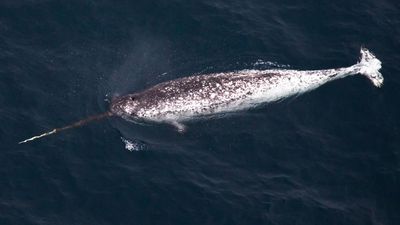


Buck teeth is one thing, but imagine if one of your canines started growing straight out from your face, not stopping until it had fully doubled your height. That’s the reality for narwhals though: their iconic unicorn-like “horn” is in fact a tusk – or, in simple terms, a single, massively overgrown tooth.
Unlike your teeth, though, the narwhal tusk isn’t used for chewing. So why do these most unique of whales have such a strange feature?
Well, truth is, we don’t entirely know. But we have some ideas.
The tooth of the matter
Lots of animals have teeth – but none have teeth like the narwhal. Seriously: it’s “unique”, said Danielle Olson for the Smithsonian’s National Museum of Natural History. “No other animal’s tooth is like it.”
Why? Because the narwhal’s tusk is kind of… well, inside-out. “Like human teeth, the tusk has many sensory nerve endings,” explained Olson. “But [in] a narwhal tusk […] the nerve system of the inner core connects directly to the outside of the tusk.”
The surface of the tooth, rather than being the solid and unbroken spears they appear, are in fact covered by millions of open pores, each leading to a central pulpy core full of thousands of exposed nerve endings and blood vessels. “In a human, that would not only be unpleasant but excruciatingly painful,” pointed out Richard Sabin, a marine mammal expert at the Natural History Museum, London – that’s why, in our own teeth, these “tubules” leading to the core are sealed before they reach the outermost enamel coating.
But “with a narwhal, it appears that their tusk has some kind of large-scale sensory function,” Sabin explained. “It could be that it allows them to detect changes in water temperature, salinity or water pressure.”
It’s not just a neat little extra for the whales. The ability to sense these properties is likely important to the point of lifesaving for narwhals, who eke out their existence in some of the coldest waters on the planet. Up in the Arctic, a sudden change in temperature – even one of only a few degrees – can freeze over the few holes in the ice, leaving the narwhals with no way of coming up to breathe.
With their lives on the line, then, the tusk’s ability to sense changing temperatures and salinity in the water – both predictors of sea ice cover – is invaluable. “Perhaps a narwhal uses its tusk to check the weather forecast,” Olson said, “and then steer clear of the colder and saltier water.”
It’s a convincing idea… with just one incredibly confusing problem.
One-twoth of the species
As inseparable as the narwhal and its tusk are – or, you know, ought to be – the truth is that surprisingly few of the animals actually have one. It’s mostly a male thing: “In the majority of cases, erupted tusks appear only in males,” Sabin confirmed, “and the left-side tusk is the one that tends to emerge, growing with a left-handed spiral.”
It’s a discrepancy that lends credence to one of the most obvious explanations for that characteristic elongated tooth: it’s to make males look sexier to potential mates. That’s what one 2020 study, descriptively titled “The longer the better: evidence that narwhal tusks are sexually selected”, concluded: that “the information being signalled [by the tusk] is simple: ‘I am bigger than you’.” (That boast should be taken literally, by the way – according to another study from 2014, a male narwhal’s tusk length is positively correlated with their ball size.)
Meanwhile, fewer than one in six females have a tusk – though “if you look inside the upper jaw and remove sections of bone as we have done with a few skulls in the collection, you can see two small, un-erupted tusks,” Sabin said. “They might serve a purpose we’re not currently aware of, but they certainly have no external function.”
But here’s the thing: that’s kind of strange, right? If tusks are so vital for the animals’ survival, then it makes little sense for half of them – the half that carries the offspring, no less – to not have any.
Why should that be? Maybe the tusk only became this super-sensor organ after becoming a mostly-male feature – or it could be that its sensory capabilities are mostly used not for cold sea ice, but females in heat. For now, all we can do is guess on this one – after all, narwhals are notoriously difficult to study. “They spend most of their life underwater at very deep depths,” pointed out Kristin Laidre, then a marine mammal biologist at the University of Washington’s Polar Science Center, back in 2012. “You have to travel several hundred kilometers offshore in dense sea ice to get to them.”
“They're really shy and easily scared away,” she added. “They can sneak right past you and you won't even see them.”
A stunning smile
Even though they’re teeth, narwhals don’t use their tusks for chewing – but they do use them for eating. Kind of, at least. “Like killer whales and most toothed cetaceans, narwhals are suction feeders,” explained Sabin – they create a vacuum in their mouth and simply slurp up the fish unlucky enough to be drawn in. But the problem with live fish is, sometimes they swim away – and so the narwhals have evolved a neat little trick known to science as “bopping them on the head to stun them first.”
“You see them tapping the fish and sucking them in, swallowing them whole,” Sabin said. “It could be that this is one of the main functions of the tusk, or simply an opportunistic benefit the males have realised and incorporated into their feeding behaviour.”
It was only very recently that this was discovered – and it took the researchers, who saw it via drone video deployed to estimate population numbers – by surprise. So too did their observations of narwhals using their tusks for playing, foraging, and exploration, in incredibly dextrous and precise ways.
“I have been studying narwhal for over a decade and have always marveled at their tusks,” Cortney Watt, a research scientist and team lead at Fisheries and Oceans, Canada, and coauthor of the study, said at the time. “To observe them using their tusks for foraging and play is remarkable.”
Whether for play, hunting, mating displays, weather forecasting, or some completely different reason we’ve yet to find, the narwhal’s tusk is endlessly fascinating. And perhaps, like Watt and her colleagues, future researchers will be able to glean more about their purpose using drones – meeting the marine recluses where they are instead of hoping they’ll come to us.
“This unique study where we set up a remote field camp and spent time filming narwhal with drones is yielding many interesting insights,” Watt said. “[It] is providing a bird's eye view of their behavior that we have never seen before.”