Nature
 PUBLISHED
 2
2


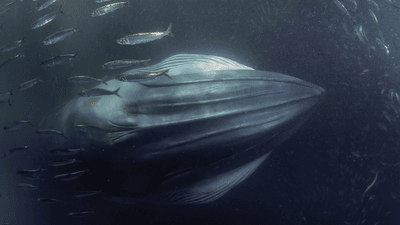


An artificial intelligence (AI) tool that’s being compared to “Shazam for whales” has cracked an ongoing mystery at the Mariana Trench. A bizarre sound, source unknown, had been ringing out in this stretch of the Pacific, puzzling scientists. At last, we know it’s a Bryde’s whale.
The moaning was first detected back in 2014 and it had marine experts stumped, thinking it sounded more like ship noise than any Mariana Trench animals. They figured it must be some kind of whale, but exactly what? That was the mystery.
“It was assumed to be produced by a baleen whale,” said the study authors, “but without visual verification it was impossible to assign a species.”
Armed with their recordings, which the team called a “Biotwang”, they enlisted the help of Google researchers who were working on an AI tool for identifying whale vocalizations. They used a combination of visual and acoustic survey data collected in the Mariana Archipelago, and were eventually able to match their Biotwang up to the Bryde’s whale, Balaenoptera brydei.
This was an exciting discovery as we don’t know much about the population structure and movements of these globetrotting whales. By combining manual and AI approaches, they combed through historic Biotwang recordings taken from across the central and western North Pacific and were able to identify a consistent seasonal presence of the moaning in the Mariana Archipelago and to the east at Wake Island. Occasionally, the whales were even Biotwanging as far away as the Northwestern Hawaiian Islands and near the equator off Howland Island.
“The seasonal occurrence of Biotwangs is consistent with Bryde’s whales migrating between low and mid-latitudes, with a small peak in calling between February and April and a larger peak between August and November as the whales travel past the recording sites,” say the authors.
“Our results provide evidence for a pelagic western North Pacific population of Bryde’s whales with broad distribution, but with seasonal and inter-annual variation in occurrence that imply a complex range most likely linked to changing oceanographic conditions in this region.”
The study is published in Frontiers in Marine Science.
[H/T: New Scientist]