Nature
 PUBLISHED



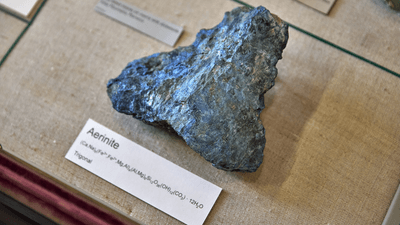


In 1995, the Natural History Museum (NHM), London, had a mystery on its hands. A rather attractive, triangular, but ultimately mysterious lump of blue mineral.
It was delivered to their doors by broadcaster Anna Grayson. The gift was tasked to a team of experts led by the late Dr Gordon Cressey, and they had quite a job ahead of them.
The blue mineral didn't look like anything they’d ever seen before. It was so unique, in fact, that they suspected it was new to science. So, what was it?
When Grayson purchased the mineral in 1980, it was sold to her as lapiz lazuli by a stall owner near Fez, Morocco. The region is famous for its minerals, but Grayson – a geologist herself – wasn’t convinced by the ID she had been given.
So she attended a museum open day that invited visitors to bring specimens for identification. So curious was Grayson’s rock that Cressey’s team ended up analyzing it for over a year.
When faced with a mineral of unknown origin, a synchrotron X-ray can be very revealing. It fires electrons around a circular path at nearly the speed of light, creating intense X-ray beams that can be reviewed to establish a sample's identity.
The results? Aerinite!
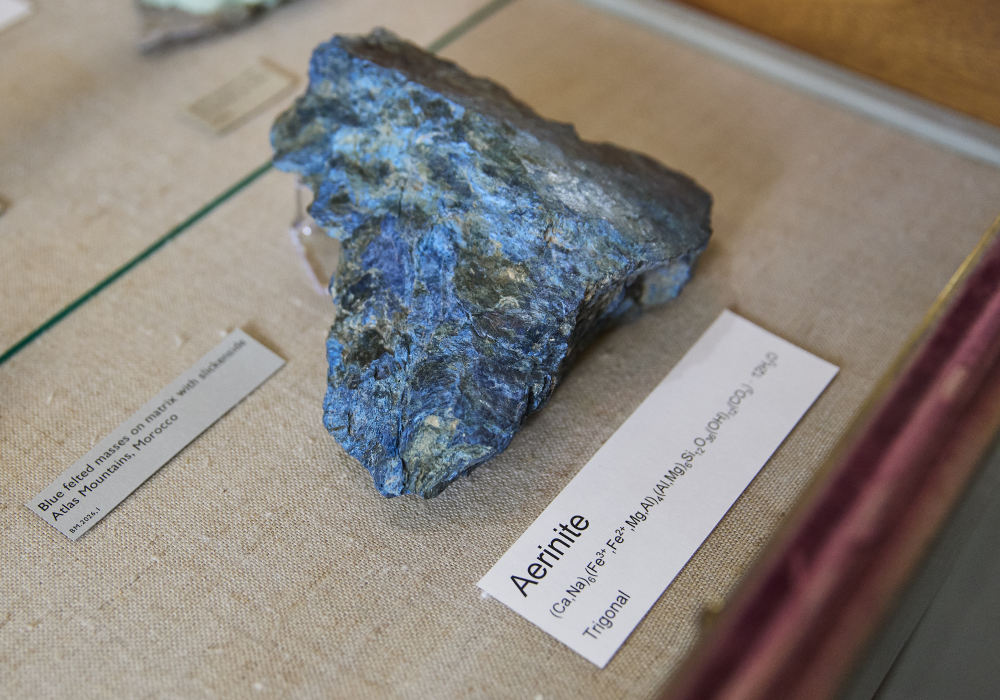
While extremely cool, this meant the sample was't an undiscovered material. Aerinite was first described back in 1876. Its name comes from the Greek for “blue sky”, and its color is created by the way it transfers electrons between iron atoms.
Grayson’s rock was made up for millions of crystal fibers measuring less than 1/10,000th of a millimeter in size. Chains of the iron ions Fe²⁺ and Fe³⁺ run along these crystal fibers, facilitating the transfer of electrons between atoms. The mechanism means light gets absorbed as it hits the mineral, so depending on which way you look at it, aerinite can appear colorless or vivid blue.
Now, 30 years after its first analysis, the aerinite sample is returning to the museum. In that time a team led by Jordan Rius in Barcelona established the unique atomic arrangement of aerinite, but the sample itself also led to the identification of several other anonymous mineral samples at the NHM.
“This work is a testament to how studies of the mineral kingdom drive technological and analytical advancements, which in turn support researchers worldwide to uncover the secrets of our natural world and develop the functional materials that are driving the energy transition,” said Dr Paul Schofield at the Natural History Museum in a release emailed to IFLScience. “Our investigation into this blue mineral garnered a lot of public attention and proved vital in the work of the Museum’s mineralogy team in classifying other specimens both in our collection and new to science.”
“It’s fantastic to see this ‘blue mineral’ sample back at the Museum, it created such excitement when Anna brought it in during National Science Week. Working with Gordon to measure and understand the unique properties of aerinite took us to many different laboratories around the country. It was such an exciting time, a journey of scientific discovery.”
Want to find out more? If you happen to be in London, the blue aerinite sample is now on display in the NHM’s Minerals Gallery, a free gallery for Museum visitors.