Space and Physics
 PUBLISHED


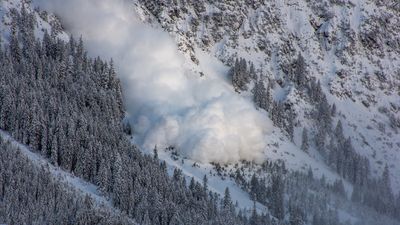


An astrophotographer attempting to create a timelapse of trails of stars behind Mount Xiannairi in Sichuan, China, ended up capturing a strange blue light being emitted during an avalanche.
Shengyu Li set up the timelapse on October 27, when a block of ice broke free from the mountain and sparked a small avalanche. Avalanches happen pretty frequently, but it soon became clear Li had captured a particularly interesting one. Take a look at the footage below, and you will see a blue flash as the ice and snow descends.
"We have not found any previously documented cases of such an event, making this discovery both thrilling and intriguing for us," Li told Spaceweather.com. "Our initial hypothesis is that the luminescence may result from friction-induced lighting during the fragmentation of ice."
While rare, the phenomenon was also captured just a few weeks earlier on October 3 on Muztagh Ata, by Lu Miao, again during an avalanche.
So, what is going on here? Weirdly, you can see a related effect by smashing a Wint-O-Green Lifesaver mint with a hammer, known as triboluminescence.
While we know a little about the effect, and mechanisms behind it, it is not fully understood.
"Triboluminescence is the emission of spontaneous light by mechanical force. This mechanical force is typically activated as a result of frictional contact such as rubbing or scratching," a review on the topic explains. "Triboluminescence is a cold light emission that is activated by the mechanical force of rubbing, scratching, or other frictional contacts. Another form of luminescence occurs when the mechanical force is sufficient to break material bonds resulting in fracture. This luminescence is referred to as fractoluminescence, fracture stress-mechanoluminescence, or fracture triboluminescence."
As noted by SpaceWeather.com, previous scientific papers have noted electromagnetic emissions (EME) associated with growing cracks in ice, and cracks under mechanical stress.
"The main cause of EME from cracks in natural ice is the so-called 'frozen-in' or 'intrinsic' electrical field that is always presents in both sea and freshwater ice. This electrical field is generated by spatial nonuniformity in the concentration of ions dissolved in the ice bulk," one paper explains.
"Mobile ions trapped in the ice bulk then diffuse against the gradient of their concentration, generating electrical charge transport and an intrinsic electrical field in ice."
This charge buildup is small, but can be more dramatic when cracks appear quickly.
"When an ice mass is split by a crack rapidly growing in the direction perpendicular to the electrical field, the field generates two surface charges of the opposite sign on the opposite surfaces of the crack," the paper continues. "Such a large potential difference can easily explain why the intrinsic electrical field dominates among the causes of EME from cracks in ice."
Such a dramatic effect, as seen in the mountains, however, is as rare as it is sparkly.