Space and Physics
 PUBLISHED



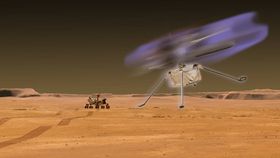


The whirling blades of helicopters on Mars could be enough to create the peculiar phenomenon known as St Elmo’s fire, a plasma discharge often created around ships and planes during electric storms. Theoretically, according to NASA scientists, this could be significant enough to make the blades of a Martian helicopter glow at dusk.
NASA’s Ingenuity has been flying on Mars for just 10 months but its wild success has given scientists and engineers plenty to consider for the future. The little 'copter that could has opened the doors for autonomous flying vehicles to explore other worlds in the Solar System and inspired people's curiosity about what it's actually like for a helicopter to fly in such a thin and dusty atmosphere as Mars'.
In a paper published in Planetary Science Journal, researchers studied the possible triboelectric charging on the blades of a helicopter on Mars. The process is similar in principle to creating static electricity by rubbing a balloon on a wool sweater, a matter of friction.
On Mars, as the blades quickly spin they may hit tiny dust grains, transferring an electric charge onto the blade. As this accumulates, it could create a current which in turn would push free electrons in the atmosphere about, hitting carbon dioxide molecules — the main component of the Martian atmosphere. This is in turn would produce more electrons, amplifying the currents.
The currents are small enough to not harm a drone with its rotor spinning on Mars, but they might be large enough to cause an "electron avalanche" which may cause the air around the craft to glow a blue-purple color. But if this is possible, sadly, we won’t find out with Ingenuity.
“The faint glow would be most visible during evening hours when the background sky is darker,” lead author William Farrell of NASA’s Goddard Space Flight Center said in a statement. “NASA’s experimental Ingenuity helicopter does not fly during this time, but future drones could be cleared for evening flight and look for this glow.
“The electric currents generated by the fast-rotating blades on drones are too small to be a threat to the craft or the Martian environment, but they offer an opportunity to do some additional science to improve our understanding of an accumulation of electric charge called ‘triboelectric charging’.”
The team believes that this effect can be measured with future helicopters and, who knows, maybe even see the spinning blades glow if the physics permits.
“In theory, there should be some effect, but whether the electron avalanche is strong enough to create a glow, and if any weak glow is observable during operations all remain to be determined in future drone flights on Mars,” Farrell said. “In fact, one could even place small electrometers up near the blade and at the legs to monitor the effects of any charging. This kind of electrical monitor could be of both scientific value and provide critical input on drone health during the flight.”