Nature
 PUBLISHED


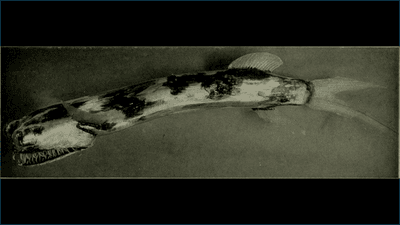


If your first thought upon seeing the header for this article was “what the f**k is that?!”, don’t worry – we thought the same, and we see a lot of weird stuff in this job. The deep-sea demon that is the telescopefish might just be the most bizarre though, but frankly, that makes it all the more intriguing.
Belonging to two species called Gigantura indica and Gigantura chuni, the telescopefish get their name from their unusually long, tubular eyes, jutting forwards from their heads. This might make them look cartoonishly nosy, but it’s actually a pretty decent adaptation to their environment.
Telescope fish are deep-sea dwelling creatures, found in tropical and subtropical regions of the ocean at depths between 500 to 2,000 meters (1,640 to 6,562 feet). There’s barely any light that penetrates down that far, but the telescopic shape of these peepers helps the fish to better spot their prey in the darkness.
Such prey might include distant, bioluminescent creatures, but also those that don’t glow. To spot these, it’s thought that telescopefish position themselves so that their eyes are facing upwards, enabling them to spot the silhouettes of prey moving around up above.
And when it comes to their prey, these fish are more than ambitious. You might have noticed their decidedly terrifying set of sharp teeth; these are attached to a jaw that can open wide enough for telescopefish to fit in prey up to twice its own size, a technique that’s also been adopted by other freaky deep-sea fish like the black swallower and Sloane’s viperfish.
The good news for those of you about to use this as the reason to add telescopefish to the cast of your nightmares, fear not. Not only are we not swimming about at the depths in which telescopefish live, but even if we were, they wouldn’t be quite as jumpscare-inducing as you might think – they’re only about 15 to 20 centimeters (6 to 8 inches) long, so we’re very much off the menu even if it were based on size alone.
Once big, thankfully non-human prey has been secured by telescopefish, it’s folded in half so that it fits inside the stomach, which has its own adaptations for life in the dark. You see, these fish are translucent – and that could easily present a bit of a problem once they’ve chowed down on a bioluminescent treat. It’s all well and good being satiated, but that feeling’s unlikely to last for long if whatever is glowing in their stomach attracts a predator to eat them too.
To combat this, telescope fish have developed a dark black stomach, meaning they’re easily able to hide whatever unfortunate bioluminescent creature is lying within. A nifty trick for life down in the deep, where survival seems to us as though it should be impossible.
Fancy finding out about some slightly less scary-looking, but equally awesome deep-sea dwellers? Then check out the newly discovered glow-in-the-dark shark and ghost-like porcelain crabs found off the coast of Western Australia.