Nature
 PUBLISHED


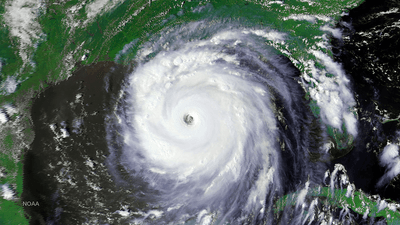


Hurricanes can be quite the nuisance. In 1947, the US attempted to deal with the problem by sending an Air Force B-17 aircraft out to drop dry ice into the center of one, hoping to find a way to quench these storms before they can make landfall, or redirect them away from where they will cause the most destruction.
It ended up being one of the more controversial attempts at controlling the weather, and the final attempt by Project Cirrus to redirect a hurricane.
In 1946, American chemist and meteorologist Vincent Schaefer found out an interesting effect with supercooled water, or water that is below 0°C (32°F) but nevertheless remains as a liquid due to a lack of a "nucleation" site to begin freezing.
Schaefer found that introducing a little dry ice into the mix resulted in the supercooled water freezing into ice. Furthermore, he realized that the same could be done in the troposphere – dry ice could be used to seed clouds, altering them and potentially causing precipitation.
General Electric, at Schaefer's urging, reached an agreement with the Naval Research Laboratory and Army Signal Corps to form Project Cirrus. The goal was simply to test cloud seeding, and soon the team moved on to wondering what would happen if they dropped dry ice into a hurricane. Would it be possible to redirect one of these beasts, or other tropical cyclones, off their course? Or significantly weaken them, before they could do damage?
At first, their goal was to search for a young hurricane as it formed for the experiment. In the pre-satellite era, this wasn't as simple as looking at images of the Earth from above, and by October 1947 they were still out of luck on this front.
"On Oct. 12th, a hurricane (designated 'King' by the Air Force Hurricane Office) moved northeastward over Florida, dumping tropical downpours on the southern end which caused damaging flooding that persisted for days. The next day the storm moved off the coast and continued out to sea," the National Oceanic and Atmospheric Administration (NOAA) explains.
"This seemed an ideal case for Project Cirrus, as the hurricane was no longer interacting with land and should not affect anyone after the experiment."
The team scrambled to intercept the storm and drop dry ice into it to, as the NOAA puts it, "see what would happen". The team dropped around 86 kilograms (190 pounds) of dry ice near the center of the hurricane, from an altitude of around 8,000 meters (26,000 feet).
So, was it successful? That's a little difficult to tell. What we do know is that the residents of Georgia were not happy about the operation. Shortly after the ice was dropped, the storm appeared to weaken. But the following day it strengthened again, before making landfall in Georgia and South Carolina, where it caused over $2 million in damage.
"The public claimed that the damage in Georgia had been caused by a seeding experiment, and a lawsuit was filed," a paper on the topic explains.
"However, meteorologists pointed out that hurricanes in 1906 and a week ago followed nearly the same path (Suburbs and Disaster Prevention Editorial Committee 1966), indicating that the path of Hurricane King had begun to change before seeding was performed. Because of the lawsuit, Project Cirrus discontinued seeding experiment."
While on a legal level the team were very much of the opinion that they did not send a hurricane at Georgia, they were fairly convinced that the experiment did have an effect on the storm.
"The seeding operation produced an area showing snow showers and stable snow clouds with light rain in the above -freezing region," Schaefer said of the experiment, which he witnessed from one of the aircraft present.
"The stable snow clouds covered considerable area and might have persisted long enough to affect other supercooled clouds. I concur with the estimate of Commander Rex that about 300 square miles [777 square kilometers] showed modification due to seeding operation."
However, the team noted that they were unable to penetrate into the heart of the storm (something which storm chasers do today) due to failures in their homing aids, essentially concluding that we would need to drop more dry ice into younger hurricanes in order to figure out the effect.
"The main thing that we learn from this flight," Dr Irving Langmuir, a physicist and chemist involved in the project concluded, "is that we need to know enormously more than we do at present about hurricanes."
We agree with you there, buddy.