Nature
 PUBLISHED


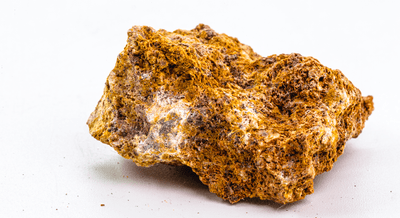


Aluminum doesn’t start life as a nice shiny metal, prepped and ready to hold your soda or wrap up your roast chicken. In fact, it usually originates as an unassuming, reddish-brown rock.
This ore is known as bauxite, a sedimentary rock that's brimming with aluminum-containing minerals. It’s most abundant in tropical or subtropical regions, where warmer weather and heavy downpours of rain favor the heavy weathering of the landscape.
Deposits are dotted in topsoil across different regions of the planet, but the largest producers are Guinea, Australia, China, Brazil, and Indonesia, according to data from the US Geological Survey.
How does bauxite turn into shiny aluminum?
Turning the ugly duckling of bauxite into shiny aluminum is a fascinating process that sounds like scientific alchemy (also known as chemistry).
First, bauxite is chemically transformed into alumina (aluminum oxide) through the Bayer process, a technique developed in 1887. Next, the alumina is then smelted into pure aluminum metal through the Hall–Héroult process, developed in the same decade.
This second stage essentially involves putting the alumina into a molten cryolite bath within a carbon-lined steel pot. An electric current is passed through the molten salt bath, causing the oxygen atoms to separate from the alumina and combine with the carbon anode, leaving behind liquid aluminum. This can be syphoned into a holding furnace and made into metal ingots.
It wasn't always this easy
Before these processes were developed in the late 19th century, making aluminum was an achingly slow and costly process.
In 1855, 12 small ingots of aluminum were displayed at a world fair held on the Champs-Élysées in Paris, shortly after Napoleon III became Emperor of the French. It blew people’s minds and the demand for the metal shot up, followed by its price.
The French elites, seemingly undeterred by the Revolution just a few decades before, would wear brooches and buttons made of aluminum to flaunt their wealth and worldliness. Napoleon III is said to have eaten off aluminum plates, while forcing his lowly guests to use mere gold ones.
Fortunately, aluminum isn't so rare nowadays
When you think of aluminum, you probably imagine a soda can or a crinkled roll of kitchen foil, but this metal is used in a wide variety of medical, military, industrial, and domestic settings, from spacecraft to solar panels.
This is because it's strong while being relatively lightweight, corrosion-resistant, and energy-efficient. It’s also infinitely recyclable because its metal structure remains strong through countless cycles of melting and resetting.
It’s even used as a food additive, like food coloring, anti-caking agents, and artificial thickeners. This is fine in small doses since healthy humans can filter out and excrete most of the aluminum they ingest, but it can be harmful at very high levels.
Quite the story for a little brown rock in the ground.