Nature
 PUBLISHED



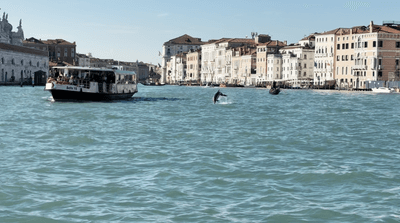


Every year approximately 30 million people visit the famous Italian city of Venice, built across iconic canals and full of boats and beautiful buildings. Central to the city are its waterways, which are used not only by people but occasionally other creatures too.
Bottlenose dolphins (Tursiops truncatus) are highly intelligent social creatures that are typically found in groups in coastal regions or in the open sea. Sometimes, however, a single dolphin can leave their pod behind and follow their curious nature in more urban settings.
"We present the case of one of the most charismatic animals in one of the most iconic cities: a solitary dolphin in Venice," said senior author Dr Guido Pietroluongo, a conservation veterinary pathologist at the Department of Comparative Biomedicine and Food Science at the University of Padova in a statement.
Mimmo was first seen in the Venetian Lagoon in June last year, and from that point on the dolphin was spotted regularly as it moved from the southern end of the lagoon towards Venice at the northern end, where it settled. Historically, the Venetian Lagoon was part of the range of these dolphins, but since the 1970s they have been less frequently observed here.
“Mimmo appears healthy and is regularly observed feeding on mullets. Since his arrival in the lagoon, any behavior displayed has been typical of the species."
The main concern for Mimmo comes from its stay in the San Marco Basin in front of San Marco’s square, one of the busiest and most popular sites in all of Venice. In this area, Mimmo is especially at risk of getting hit by boat propellers or boats themselves. The researchers suggest that controlling human behavior around the waterways through speed limits is important to keep Mimmo safe.
Precautions are also in place to stop people trying to touch or feed Mimmo, though they aren't always successful. In November 2025 acoustic deterrents and boats were used in an attempt to drive him away from San Marco Basin, but those didn't seem to dissuade Mimmo from staying, as the dolphin immediately returned. The idea of capturing Mimmo and taking the dolphin to a new place is also off the table since the animal is currently healthy, and it is believed attempting a relocation would do more harm than good.
"What is truly unusual is not the dolphin's presence, but the persistent difficulty humans have in respecting such animals today," said Dr. Giovanni Bearzi, the first author of the study. "We need to appreciate the opportunities to coexist with and enjoy wildlife. Historical and contemporary documentation clearly shows that dolphins have accompanied human maritime activities for millennia, yet we still struggle to coexist with them appropriately."
The paper is published in Frontiers in Ethology.