Nature
 PUBLISHED



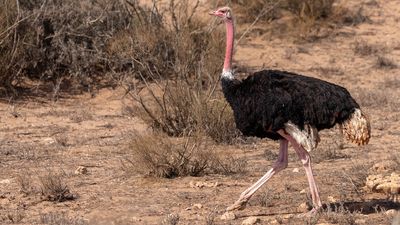


An Arabian ecosystem has received a rewilding boost in the five red-necked ostriches, also known as “camel birds”, that have been released into the Prince Mohammed bin Salman Royal Reserve as part of the ambitious ReWild Arabia program.
The Arabian ostrich (Struthio camelus syriacus) was once widespread, but by 1941 it had been driven to extinction through overhunting and loss of habitat. The red-necked ostriches (Struthio camelus camelus) will serve as a rewilding proxy, given their similarity and ability to survive in dry, desert environments.
Ostriches are the largest living birds, and red-necked ostriches are especially big, capable of growing to around 2.8 meters (9 feet) tall and weighing 150 kilograms (330 pounds). The nickname “camel birds” dates to Pliny the Elder's Natural History, published in the first century CE, as he believed they resembled camels when seen from afar.
Red-necked ostriches are also known as North African or Barbary ostriches, and there are fewer than 1,000 individuals left across Africa.
“The return of ‘camel birds’ to their historic rangelands supports the restoration of desert ecosystems shaped historically by large grazing and browsing species. Ecosystems can only be considered fully restored when lost species, or their ecological equivalents, are returned,” said Andrew Zaloumis, CEO of Prince Mohammed bin Salman Royal Reserve, in a statement.
“This is why we consider the return of the red-necked ostrich a landmark step towards the Reserve’s restoration and the establishment of a founder population for Saudi Arabia’s national breeding and restoration programmes.”
Evidence of the Arabian ostrich can still be seen in the reserve, where petroglyphs show ostriches and even hunting scenes carved into the sandstone.
The introduction of this species as a rewilding proxy marks the 12th species to be reintroduced to the nature reserve, where the ostriches will live alongside reintroduced Arabian oryx, sand and mountain gazelles, as well as the Persian onager.
The project hopes to bring back 23 native species as part of the overall program. The reserve is already one of the most biodiverse protected areas in the Middle East, with 15 distinct ecosystems and over 50 percent of Saudi Arabian species found within. However, it only covers 1 percent of the Kingdom’s terrestrial area and 1.8 percent of its marine area.