Space and Physics
 PUBLISHED


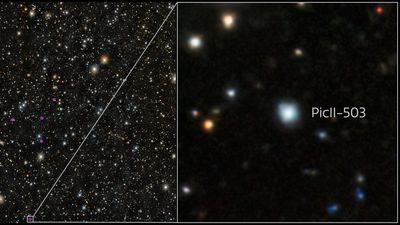


Astronomers believe that there have been three generations of stars in the universe. The first, which are yet to be seen directly, were made of just hydrogen and helium. The Sun is among the last ones, also mostly hydrogen but enriched in the heavier elements that also make planets, such as iron and calcium. In the middle, the second generation is slightly enriched in some elements, but truly only a smidge. Now, researchers have found one of the most extreme examples of this second generation.
The star is known as PicII-503, and it resides in the tiny, ultra-faint dwarf galaxy Pictor II. It has the lowest iron and calcium abundances ever measured in a star outside of the Milky Way, with 1/43,000th of the iron and 1/160,000th of the calcium found in the Sun. The star has so little enrichment in heavier elements that it might have been one of the earliest second-generation stars known.
“Discovering a star that unambiguously preserves the heavy metals from the first stars was at the edge of what we thought possible, given the extreme rarity of these objects,” lead author Dr Anirudh Chiti, from Stanford University, said in a statement. “With the lowest iron abundance ever derived in any ultra-faint dwarf galaxy, PicII-503 provides a window into initial element production within a primordial system that is unprecedented.”
Pictor-II is a satellite of the Milky Way located 149,000 light-years from Earth. PicII-503 lies at the outskirts of this small galaxy. That fact, combined with a relative overabundance of carbon compared to the heavier elements – this star has 1,500 times more carbon than iron and 3,500 times more carbon than calcium compared to the Sun – tends to suggest how this object came to be.
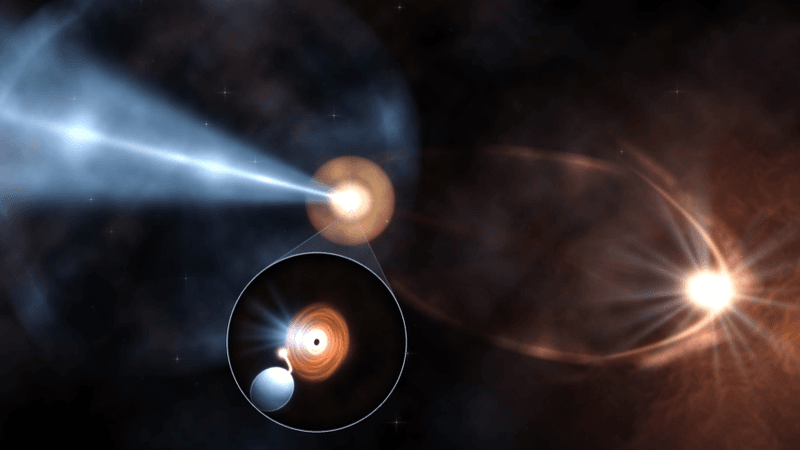
The team believes that the progenitor of this particular star was not an enormous first-generation star going supernova, producing all the heavier elements, but a lower-energy supernova. In this scenario, most of the heavier elements, such as iron and calcium, fall back onto the compact object (either a neutron star or black hole) that formed during that supernova.
This scenario could explain not only the composition of PicII-503, but also the carbon-enhanced, metal-poor stars that are found in wide orbits in the outer region, called the halo of the Milky Way.
“What excites me the most is that we have observed an outcome of the very initial element production in a primordial galaxy, which is a fundamental observation!” explained Chiti. “It also cleanly connects to the signature that we have seen in the lowest-metallicity Milky Way halo stars, tying together their origins and the first-star-enriched nature of these objects.”
“Discoveries like this are cosmic archaeology, uncovering rare stellar fossils that preserve the fingerprints of the Universe’s first stars,” said Chris Davis, NSF Program Director for NOIRLab. “We look forward to many more discoveries with the start of the NSF–DOE Rubin Observatory’s Legacy Survey of Space and Time later this year.”
The study is published in the journal Nature Astronomy.