Nature
 PUBLISHED


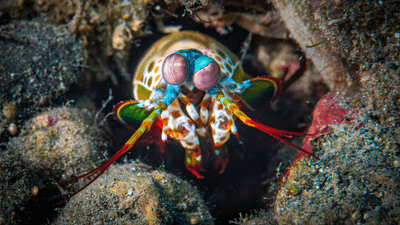


Humans have, understandably, put a lot of effort into trying to figure out if extraterrestrial life exists. Thing is, a lot of those scientists are only hoping for something in the region of microbes. If it’s dramatic lifeforms so unusual it’s hard to believe they’re real that you’re looking for, you only need visit the ocean.
The twilight zone has a lot of deep sea oddballs to boast about, but even shallower regions are home to creatures with talents we humans could only dream of. I’m talking, of course, about mantis shrimp.
Meet the mantis shrimp
Colorful, complex, and with a punch that can break aquarium glass, these crustaceans have a lot to brag about. Perhaps most impressive of all, however, is the way they see the world.
A 2008 paper was the first to announce the discovery of a fourth kind of vision in the animal kingdom. We already knew at that time that animals were capable of seeing color, intensity, and linear polarization.
Light is a kind of electromagnetic wave and when it's unpolarized it vibrates in random directions. When it moves in a specific direction, be that side-to-side or diagonal, that's known as linear polarized light.
Bees can see linear polarized light. This is because they have specialized photoreceptors in their compound eyes and they used this visual information like a natural compass, helping them to navigate.
The fourth way of seeing light scientists discovered in 2008 was circular polarized light and to date we’ve only seen it in one animal: mantis shrimp. We knew this kind of light was reflected by some animals, but what was new-to-science was that any animal could see and analyze it.
It was too early at that point to know what mantis shrimp were using this superpower for, but the authors suggested it could be involved in sexual signaling and mate selection. That idea was expanded in a 2015 paper that explored circularly polarized light as a communication signal in mantis shrimps.
Sending secret signals
Signaling in the wild is a compromise. You want to make sure the desired recipient is receiving your messages while also trying to avoid any eavesdroppers picking up on them (e.g. predators, parasites, prey).
It figures, then, that a kind of light only your species is known to detect could be a good option. Scientists investigated this in a series of experiments offering captive mantis shrimp a choice of burrows.
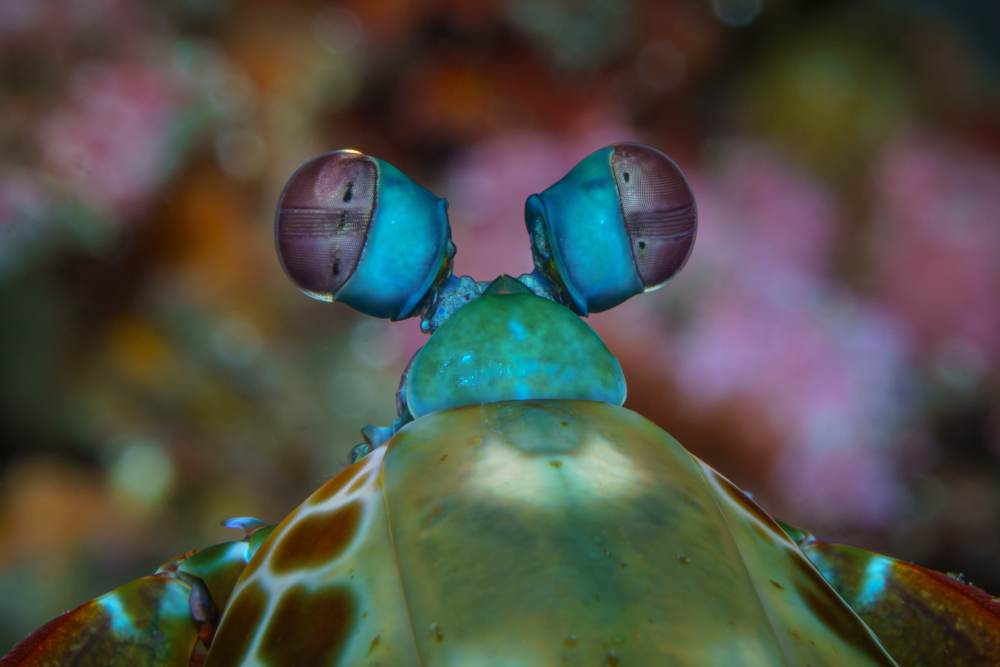
The results revealed that they would avoid burrows that contained circular polarized light mimicking the patterns found on their bodies. The researchers figured this could be a way of avoiding occupied burrows while seeking refuge, and it fits, right?
After all, you want to let would-be rivals know to keep out of your territory without also letting predators know where they can find a meal.
Eyeballs on the move
This capacity to differentiate between types of light we cannot see is also why mantis shrimp eyes are so dynamic. Whereas we need our eyes to stay still in order to see anything but a blur, a 2016 paper found mantis shrimp rotate their eyes to align photoreceptors with the direction of polarized light – another nifty trick that had never been documented in an animal before.
Research continues to explore the molecular mechanisms that enable mantis shrimp to see and respond to this light the rest of us are missing out on.
One thing our humble eyes can comprehend, however, is a recent study that became the first to image the complex mantis shrimp eye in 3D.

It used a phase contrast X-ray CT imaging technique that meant they could get a good look inside without slicing up the organ. The resulting images revealed structures to sub-micron resolution, including muscles, corneal lenses, and neural tissue.
As to whether any of this is detecting secret sexy signals as suggested in that early 2008 paper, we have yet to find out. But given everything we’ve learned about these colorful and charismatic crustaceans so far, I think it’s safe to assume they'd be watching one hell of a show.