Nature
 PUBLISHED
 5
5




If the January blues are hitting hard and you’re fed up with life as a mid-latitude dweller, here’s a radical remedy: pack your thermals and head south – way, way south.
The British Antarctic Survey (BAS) has launched a New Year’s push to find people to work at its research stations in Antarctica. Scientists and researchers are in demand, but they are also on the hunt for technical staff and support crew, including carpenters, chefs, plumbers, boat handlers, scuba divers, plant operators, and more.
You can see the vacancies and apply online right here: bas.ac.uk/vacancies. Job postings will continue to be added to the board until March 2026, plus you can sign up to receive email updates to see when new jobs go live.
Salaries start at £30,244 (around $41,285 at the time of writing) per annum, but it’s worth noting that all living expenses are covered while working here, including accommodation, food, travel, specialist clothing, tools, and training. With no rent or living costs to worry about, it’s one of the rare jobs where your pay packet can actually stay intact.co
Antarctica is the only continent on Earth with no native human population or permanently settled residents. However, it is home to a temporary community of scientists, technicians, and support staff who live there on a rotational basis. The population peaks at around 5,000 during the summer months (October to March), and it declines to roughly 1,000 during the harsh, sunless winter (April to October).
Yes, despite what flat-Earthers told you, you can visit Antarctica and even live there; it's not guarded by an impenetrable, heavily militarized ice wall.
Living and working on the planet's southernmost continent has its perks. It’s a once-in-a-lifetime opportunity to work in one of the most unique and breathtakingly beautiful places in the world. But it’s not all penguins and polar sunsets. Months of isolation, extreme weather, and limited contact with the outside world can be tough for some.
Curious if you have what it takes? Here’s what a few Antarctic veterans have to say.
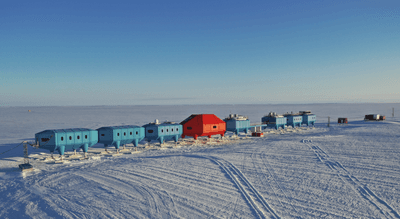
Dan McKenzie, a Station Leader at Halley VI Research Station who’s been working in Antarctica for five years, said in a statement: “I’ve been lucky enough to work for BAS in a few different places. I started off as a plumber at Rothera and now I’m in the Station Leader role at Halley VI, an incredible place, filled with talented people.”
“I always think, I’m just a lad from Wigan, who never went to university and came from pretty humble beginnings, and now I’m here. That’s the beauty of BAS, anyone can give it a try and if you work hard you never know where it will take you,” McKenzie added.
Phill Coolman, a carpenter at Halley VI in Antarctica, said: “Being a carpenter in Antarctica requires adaptability and teamwork. I’ve gained skills here that I’ve carried back to the ‘real world’ and done things I never thought I would get the chance to do.”
Jess Callaghan, a Zoological Field Assistant who’s spent the past 16 months on the sub-Antarctic island of South Georgia, commented: “Living on Bird Island is an ornithologist’s dream come true. One day, I’ll be working among our colony of 45,000 macaroni penguins, and the next I might be helping weighing Antarctic fur seal pups. If you’re passionate about wildlife and are looking for an overseas adventure, I simply could not recommend this once-in-a-lifetime opportunity.”