Space and Physics
 PUBLISHED
 1
1



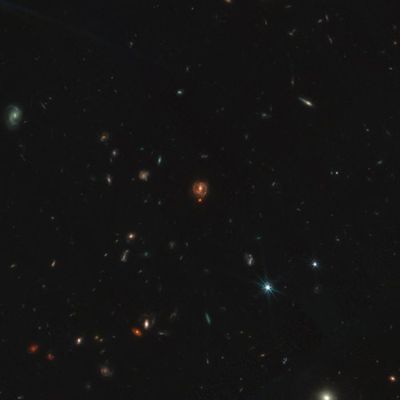


You know that a celestial mystery is juicy when different teams of scientists are all coming up with different explanations for it. You know it’s even juicier when the explanations all roughly fit the available data, and none seems to have a major edge. The mystery in question revolves around the objects known as little red dots.
These objects were seen by JWST, and they represent the very limit of the exceptional capability of the telescope. About 340 little red dots have been discovered by it so far; they originate in the very early universe, most from roughly 600 million years after the Big Bang. They appear in shape to be similar to quasars, the active state of a supermassive black hole, but they lack their X-ray emission, and look different in infrared too.
Interesting proposals for the true nature of these objects include the so-called Black Hole stars, where a stellar-mass black hole is embedded deep inside an envelope of hydrogen, creating the impression of an enormous star. They could also be very compact galaxies, with an incredible density of stars and shrouded in dust. A very recent view suggests that these are the very first generation of stars, which were 10,000 times the size of the Sun, and also shrouded in an envelope of hydrogen.
This new work proposes, once again, a shrouded object, but what sits at the center is a supermassive black hole. To avoid the expectation of a quasar, the researchers suggest that these supermassive black holes are between 100,000 and 10 million times the mass of the Sun. This would make them the smallest black holes seen at that epoch of the universe. The researchers seem to be very confident in their results.
“The little red dots are young black holes, a hundred times less massive than previously believed, enshrouded in a cocoon of gas, which they are consuming in order to grow larger. This process generates enormous heat, which shines through the cocoon. This radiation through the cocoon is what gives little red dots their unique red colour,” one of the study's principal researchers, Professor Darach Watson from the University of Copenhagen, said in a statement.
“They are far less massive than people previously believed, so we do not need to invoke completely new types of events to explain them.”
The work on little red dots continues, but it is interesting that different explanations are converging on a crucial aspect: these objects are the precursors of the largest black holes in the universe. The disagreement seems to be about what exactly is being shrouded.
The study is published in the journal Nature.