Space and Physics
 PUBLISHED






Hubble’s successor, JWST, had many goals when it was launched. It was going to see farther back into the universe than any observatory before it, allowing us to see the first galaxies, the first population of stars, and even how supermassive black holes are formed. JWST might have completed these objectives already by discovering a single class of objects.
Over 340 little red dots have been identified by JWST. They are small and at the very limit of the observatory’s capabilities. Astronomers believe they are from the very early universe, with the majority of them from around 600 million years after the Big Bang. While similar in shape to quasars, the active state of a supermassive black hole, they don't have the same characteristics in infrared, and they don't seem to emit X-rays.
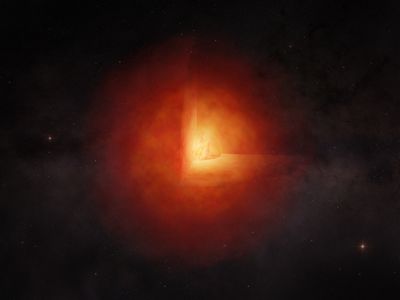
A new model suggests they might be Population III stars, which, despite the name, are the first type of stars that ever existed in the universe. Observational evidence of these stars has otherwise only been reported very recently, but they are expected to be massive, with some scenarios suggesting they can reach masses 10,000 times that of our Sun. This is so big that they quickly burn through their fuel, ending up forming enormous black holes, the seeds of the supermassive black holes at the centers of galaxies.
"Little red dots have been a point of contention since their discovery," lead author Devesh Nandal, from the Harvard–Smithsonian Center for Astrophysics, said in a statement. "But now, with new modeling, we know what's lurking in the center of these massive objects, and it's a single gigantic star in a wispy envelope.”
The team goes on to argue that their model can explain what is being seen by JWST, though this isn't the first time an envelope has been suggested to explain the structure. A separate group of researchers previously suggested the little red dots are large black holes surrounded by a hydrogen envelope.
Still, the interpretation of these objects as the crucial stepping stone for the formation of supermassive black holes is gaining traction. Other JWST research favors the idea that the seeds of these supermassive black holes are "heavy" – usually expected to be from the direct collapse of gas clouds weighing 10,000 to 100,000 times the mass of the Sun. Could an enormous star be the answer?
"If our interpretation is right, we're not just guessing that heavy black hole seeds must have existed. Instead, we're watching some of them be born in real time," said Nandal. "That gives us a much stronger handle on how the universe's supermassive black holes and galaxies grew."
With such a juicy cosmic mystery on our hands, we wouldn't be surprised if more solutions and interpretations are quick to follow, so watch this space!
The research has been accepted by The Astrophysical Journal and is available on ArXiv.