Nature
 PUBLISHED


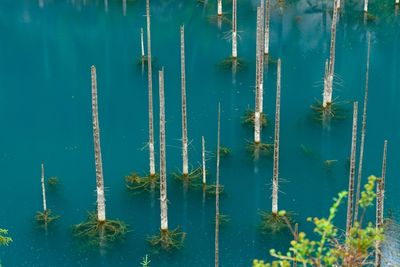


In a canyon in the Tian Shan mountains of central Asia, a forest lies almost entirely underwater. Called Kaindy Lake – the name translates to “birch” in the native Kazakh language, though the trees are actually Asian spruces – it’s a little-known idyll with an earth-shattering origin story.
The creation of Kaindy Lake
Kaindy Lake lies within Kazakhstan’s portion of the Tian Shan Mountains, where the Earth’s crust continues to be forced skywards as India and Eurasia collide on a geological timescale. That makes the area tectonically active: the mountains average about one large earthquake every three years, with most occurring in the West, where Kazakhstan sits.
It was an especially large one of these events that hit the mountains back in 1911. A magnitude 8 earthquake struck on January 3, causing the ground to fracture and landslides across hundreds of kilometers. Almost all of Almaty– then a city of around 27,000 – was destroyed; hundreds of people died; hanging objects swung from the shock waves more than 1,000 kilometers (621.4 miles) away.
And, up in the mountains near a forest of spruce trees, one landslide happened to hit a gorge. The sediment filled the area, forming a natural dam – and, over years of rain and melting glaciers, the area filled with water. No longer a forest: the trees now sit at the bottom of the 30-meter-deep lake.
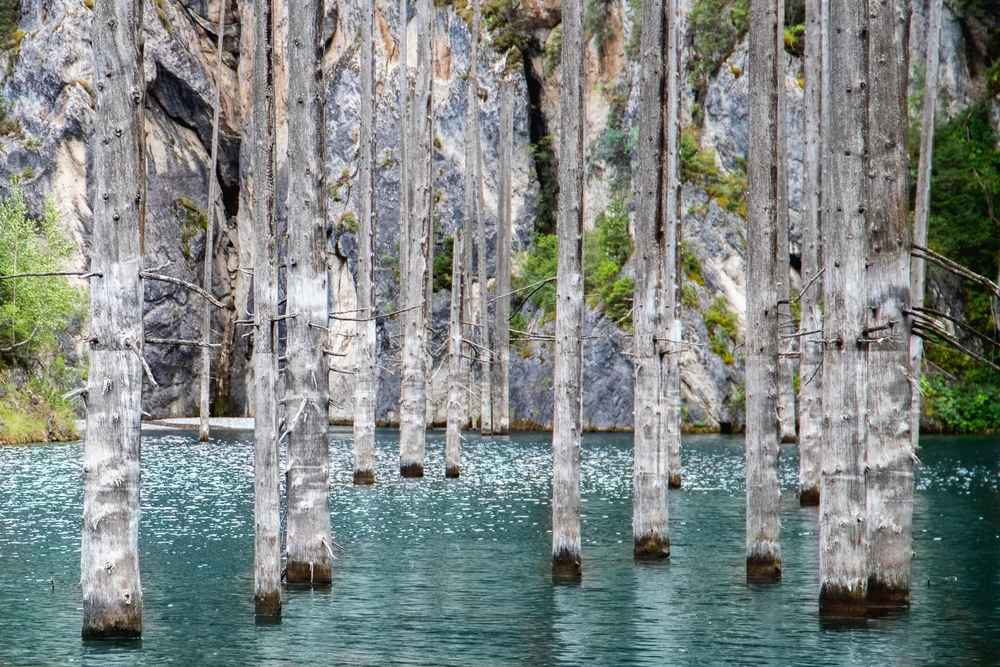
But what’s particularly striking about the lake is how the trees seem to have survived the flooding. It’s an eerie sight above the water, with the bare trunks sticking up like bones reaching for the sky – but underneath the water, the trees seem lost in time, with perfectly preserved needles still attached to their branches even now.
The reason for that is simple: “The trees have been preserved because of the cold water,” Duman Dukenbaev, from the Kolsai Koldere National Park where Kaindy Lake is located, told Euronews in 2017.
See, thanks to its high altitude – at 2,000 meters (6,500 feet) above sea level, it’s located a little higher than the summit of Mount Washington – Kaindy Lake is really, really cold. Even in summer, the water rarely gets warmer than 6°C (43°F), and in winter it completely freezes over.
Despite that, Dukenbaev said, “there are tourists who go in for a swim to see this beautiful underwater forest.”
The eerie beauty of Kaindy Lake
Tian Shan is the Chinese name for the mountains, and it means the “mountains of Heaven”. A bombastic name, perhaps, but not an undeserved one: in Kazakh, the range is called the Tengri mountains, and the second-highest peak Khan Tengri, after the sky god of the ancient local religion.
Kaindy Lake sits just about 150 kilometers (93 miles) to the northwest of Khan Tengri – far enough away that the mountain’s blood red marble peak can’t be seen. But Kaindy Lake is a hue of equal vibrancy: it’s 400 meters (1,300 feet) of sparkling turquoise water, spiked through with countless bare, bleached tree trunks.
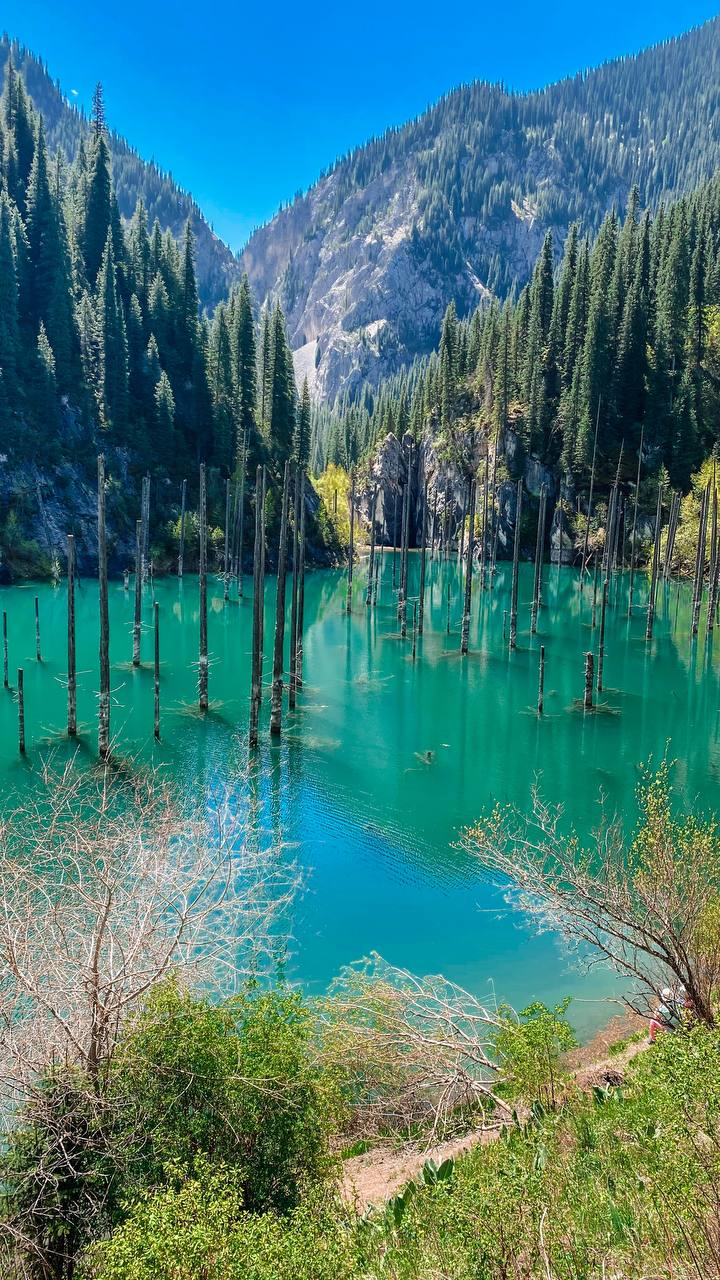
The dazzling blue is a byproduct of the landslide that created Kaindy. It wasn’t just rock or sediment that came crashing through the gorge that day – it was specifically six Great Pyramids of Giza’s worth of limestone. Composed mostly of calcium carbonate, limestone is naturally white in color – but when eroded by water, it breaks down into myriad tiny crystals which mix into the lake. These scatter the sunlight that hits the surface, particularly the shorter blue and green wavelengths, giving the water its iconic beautiful turquoise color.
But equally if not more striking are those trees. Bleached by more than a century of sunlight, the trees “poke from the water’s surface like misplaced toothpicks,” notes AllThatsInteresting – and below the surface, the picture is even more curious.
There, they “look more like shipwreck remains than an age-old forest,” AllThatsInteresting says. “In most lakes, submerged trees will rot or break down over time, yet because of Lake Kaindy’s specific conditions, the trees have remained intact for decades.”

In winter, the landscape transforms once again: the water freezes over, and the lake becomes popular among ice fishing and diving. Then, the trunks sticking eerily out from the ice become a much more practical phenomenon, as the fishermen lean against them as they wait for a bite.
Visiting Kaindy Lake
Like everything about Kaindy Lake, its status as a tourist attraction is unique and a little confusing. It’s close to Almaty – still Kazakhstan’s largest city, with a population of more than 2 million – and located within a national park, so you’d expect it to be fairly popular. And yet, despite this seemingly easy location and its stunning and unique scenery, Kaindy sees comparatively few visitors.
Some of that can surely be put down to its inaccessibility. “Only a vehicle built for rougher terrain will make it [to Kaindy],” advises Atlas Obscura. “The lake is located in forested country.”
“Depending on recent weather and the capabilities of your vehicle, you may need to take a taxi from the village up to the mountain,” they add. “Recent rain [can make] the deeply rutted roads very slippery […] It’s only about a mile up to the lake but remember you are at altitude and this is nothing like a stroll through the parks in Almaty.”
Added to that is the fact that two other lakes, Bolshoe Almatinskoe and Kolsay, are located pretty nearby – Kolsay within the same park, in fact. They’re both better known, and easier to get to, and so most people wanting a day by a lake in the area will prefer to go to one of those.
Still, there’s an upside to all that. If you decide to go for it, and hike to Kaindy Lake, you’ll be greeted with a relatively secluded resort like nothing you’ve seen elsewhere. “Kaindy Lake is […] idyllic,” Atlas Obscura says, but “sees few visitors.”
“Despite its proximity to a city with a population of more than one million, the lake retains a peaceful atmosphere.”


 3
3