Nature
 PUBLISHED


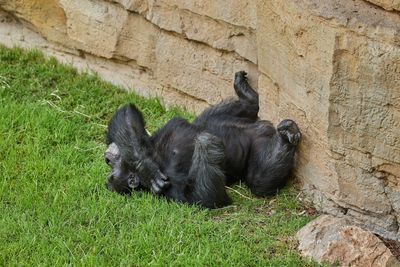


We sometimes hear of wild animals getting “drunk” on rotten fruit and doing something silly, but just how much alcohol are they really consuming? A new study has looked at the boozy behaviors of a group of wild chimpanzees, taking on the unenviable task of collecting and testing their pee to find out more.
In humans, a breathalyzer is a preferred method of testing alcohol levels, but take that to a group of chimps, and you are probably going to run into some issues. However, the team behind the study managed to come up with an alternative solution.
During an 11-day trip to Ngogo, in Uganda's Kibale National Park, in August 2024, the researchers created shallow plastic pee collectors strung between forked sticks to act as receptacles to collect the chimps' urine. Combining this with pee collected from puddles and leaves in the forest, the team gathered enough of a sample to begin testing.
The results revealed that most of the chimps' urine contained ethyl glucuronide, a product created when alcohol is broken down in the body. This suggests that the chimps are eating a fair amount of fermenting fruit – they were seen feeding almost exclusively on white star apples – resulting in significant quantities of ethanol in their diets.
In fact, the team found that of the 20 samples they tested from 19 different chimpanzees, only four of the 20 had a concentration below 500 nanograms per milliliter of ethanol. In humans, over 500 nanograms per milliliter is expected after a couple of drinks consumed within the last 24 hours.
“The levels are high, and this is a conservative estimate given the time course of exposure through the day,” study author Robert Dudley, a UC Berkeley professor of integrative biology, said in a statement. “In nanograms per milliliter, these are coming in way above some of the clinically relevant and forensically relevant human thresholds.”
All this data helped the researchers fill in gaps in the “drunken monkey hypothesis”, a theory that proposes the animals are ingesting alcohol naturally and even looking for it. It's even suggested that, as descendants of fruit-eating apes, this is where humans got their tendency towards alcohol from.
“We find widespread physiological evidence of the consumption of alcohol by chimpanzees,” Aleksey Maro, the study's first author, said. “If there's any doubt about the drunken monkey hypothesis – that there's enough alcohol in the environment for animals to experience alcohol in a way analogous to humans – it's been cleared up.
The study is published in Biology Letters.