Nature
 PUBLISHED


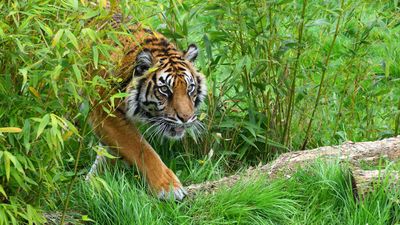


Once declared extinct, a type of Indonesian tiger may still be around, recent DNA analysis has tentatively suggested. Much more research is needed to be certain, but conservationists say there is now a glimmer of hope the Javan tiger could still be out there, roaming the island’s forests.
The Javan tiger (Panthera tigris sondaica) was categorized as Extinct on the IUCN Red List back in 2008. Since then, there have been a handful of potential observations, each without substantiative evidence to back them up. However, in 2019, locals sighted what they thought was a Javan tiger near the village of Cipendeuy in the forest of South Sukabumi, West Java, alongside footprints and claw marks. They collected a single hair from a nearby fence.
Analysis of this hair points towards it belonging to a Javan tiger, although further research is needed to confirm its existence. “Whether the Javan tiger actually still occurs in the wild needs to be confirmed with further genetic and field studies,” the team concludes in their study.
Still, the prospect has stirred public interest, and even efforts among Indonesian conservationists to investigate whether this “extinct” big cat is indeed still alive and kicking.
"The research has sparked speculation that the Javan tiger is still in the wild," Satyawan Pudyatmoko, the Indonesian ministry official who oversees conservation, told Reuters. "We have prepared and will prepare efforts to respond to it."
According to Reuters, these include setting up camera traps and conducting extensive DNA sweeps, as well as seeking advice from genetics experts to identify any that may remain in the wild.
The Javan tiger was native to Indonesia, one of three subspecies of tiger formerly found in the country. In 2013, the Bali tiger (P. tigris balica) was also declared Extinct by the IUCN, leaving just the Sumatran tiger (P. tigris sumatrae) surviving.
Hunting and destruction of habitat are thought to be among the causes of the Javan subspecies’ extinction
In the new research, scientists studied mitochondrial DNA (mtDNA) – maternally inherited genetic material found outside the nucleus – from the hair and compared it with that of a Javan tiger museum specimen, collected in 1930. Hair samples of several tiger subspecies and the Javan leopard (Panthera pardus melas) were used as controls.
“From this comprehensive mtDNA analysis we conclude that the hair sample from South Sukabumi belongs to the Javan tiger, and that it falls in the same group as the Javan tiger museum specimen collected in 1930,” the team write.
Whether or not the subspecies still exists in the wild is another matter. But with the efforts the latest discovery has inspired, we might soon find out – and then, if it turns out there are still some Javan tigers out there, we’ll have to do what we can to protect them.
"If, for example, it is proven that it still exists, it will certainly become a protected animal,” Pudyatmoko told AFP. “It is the obligation of all parties, including the society, to participate in preserving their population."
The study is published in the journal Oryx.