Space and Physics
 PUBLISHED





Mercury has always been a bit of an oddball planet. With about half the mass of Mars but roughly the size of the Moon, and a cratered surface baked by intense sunlight, Mercury is peculiar to say the least. It was believed that the planet was geologically dead, with not much activity going on under its crust. New observations now challenge that notion.
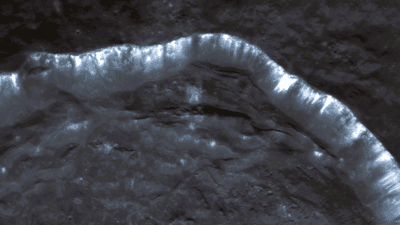
Researchers report the discovery of lineae, streaks across the slopes and craters of the planet. They believe that these were created by outgassing – volatile material from deeper in the planet coming out from cracks, on slopes, and from the edges of craters. Most streaks appear from bright hollows that might have also been sprayed by this outgassing.
The discovery was possible thanks to analysis of about 100,000 high-resolution images of Mercury from NASA's MESSENGER, which studied the planet from 2011 to 2015. The team found 400 examples of these slope lineae across the planet.
"Until now, lineae on Mercury had not been systematically mapped and studied; only a small handful of streaks were known. With the image analysis, we were able to create the first census, i.e. a systematic inventory, of slope streaks on Mercury," first author Valentin Bickel, from the University of Bern, said in a statement.
The team found that the lineae occurred preferentially on the Sun-facing slopes of the younger impact craters. This suggests that it is not just the activity of the planet, but also the solar radiation and the heat that help liberate the lighter elements trapped beneath the surface.
"With our analysis, we were therefore able to propose that slope lineae are probably formed by the outgassing of volatiles such as sulphur or other light elements, that are sourced from the interior of the planet," Bickel continued. "Our findings paint a completely different, dynamic picture of the supposedly dead, dry and boring planet Mercury."
These findings are very important as they paint a more intriguing picture of the smallest and innermost planet. They are also extremely timely. Mercury is about to be studied like never before. The European-Japanese mission BepiColombo will enter orbit around Mercury at the end of the year, with its science mission starting in early 2027.
BepiColombo is bringing two spacecraft to Mercury, which will create a detailed map of the surface, studying the hidden ice in the polar craters, the planet’s magnetic field, and even the hollows mentioned in this study. The team hopes to use data from BepiColombo to confirm this work.
The study is published in the journal Nature Communications Earth & Environment.