Nature
 PUBLISHED


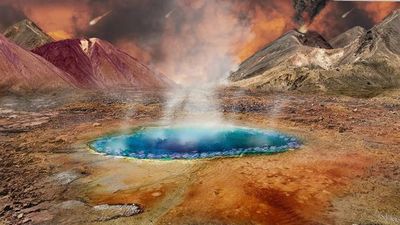


Iron sulfides in hot springs around volcanic vents on land could have provided carbon in the form the earliest life needed to get started. A demonstration of the effectiveness of doped iron sulfide as a catalyst in these environments shows there is a third contender in the contest for life’s first home, along with Darwin’s Pond and hydrothermal vents on the ocean floor.
We may never be able to reconstruct the first spark of life perfectly, but strong suspicions exist as to some of the necessary ingredients, inspiring searches to find where they would have been available on the early Earth. Methanol (CH3OH) is currently in the news for killing backpackers in Laos, but it can bring life as well as death, and is thought to have been a possible source for the carbon in the amino acids of the first life forms.
Today enzymes allow the conversion of carbon dioxide into molecules usable by an array of life. However, these enzymes are made by living cells, so a non-biological alternative is required to explain how the carbon became available initially. Iron sulfides can catalyze reactions that turn carbon dioxide into methanol and other simple molecules. These could have undergone further conversions into building blocks of life.
Work has previously been done establishing that iron sulfide (FeS) could perform the necessary role under the conditions we think existed around deep ocean hydrothermal vents.
However, hot springs on land also have supporters as the cradle for life, made more relevant from evidence Mars had them as well. A team led by Dr Jingbo Nan of the Chinese Academy of Sciences decided to explore how well iron sulfides would perform under those conditions.
Hot water acting on certain rocks is thought to have provided a source of hydrogen, both in the air and dissolved in the water, but on its own would be very inefficient at turning carbon dioxide into methanol.
The team sought to replicate the key aspects of hot springs prior to life, and see if iron sulfides could stand in for catalyzing enzymes. They experimented with pure FeS, but also tried iron sulfide nanopowders mixed with small amounts of manganese, nickel, titanium, and cobalt, each of which should have been present in some springs.
At temperatures between 80–120°C (176-248°F), the iron sulfide catalyzed reactions in which molecular hydrogen reduced carbon dioxide, which would have been abundant before life began. High pressures were not required.
Doping the iron sulfides with manganese increased methanol production five-fold, but the other metal impurities made things worse.
Intriguingly, water vapor slowed production below 100°C (212°F), but sped it up above that point, which the authors think may be because it contributes protons to the carbon dioxide conversion process when temperatures are high enough. Exposure to UV light stopped methanol production entirely under sub-par conditions, but allowed it when circumstances were generally more favorable. UV is thought to have been crucial for some of the reactions that came afterwards, making its presence an argument for shallow water conditions over the deep ocean. If it stopped methanol production, however, it would be tricky to explain how it could only be present when it was needed.
The way water vapor and UV are sometimes a problem, but not always, indicates that most of Earth’s early hot springs were probably unsuited to starting life. However, circumstances only needed to be right once, and the work suggests an excellent combination was probably not that rare.
The reaction appears to involve carbon dioxide being reduced to carbon monoxide, which then reacts with hydrogen to make methanol with the second step needing less energy in the presence of manganese.
Perhaps Darwin’s “warm little pond” was actually a hot, bubbling one.
The study is open access in Nature Communications.